

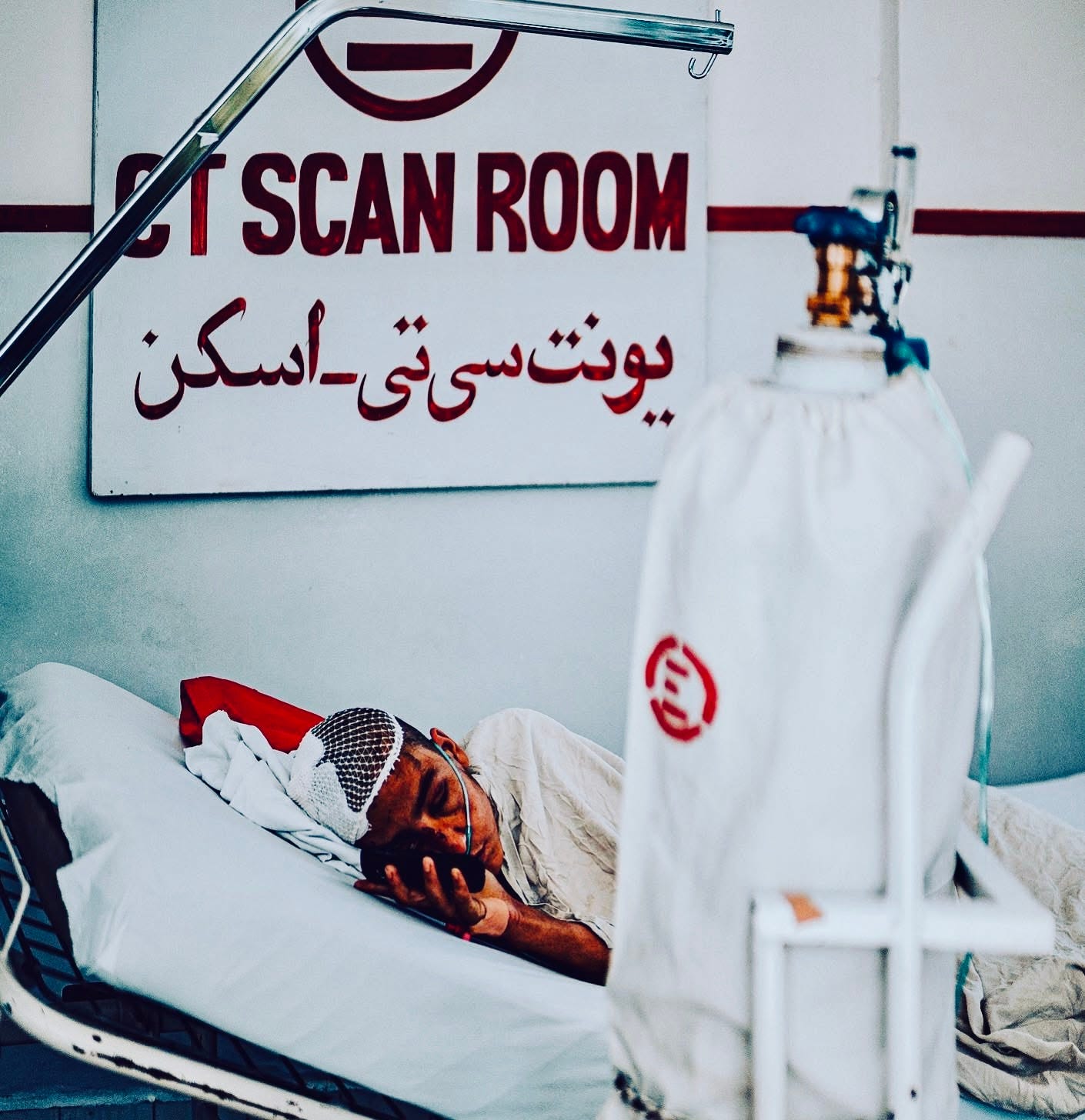
Abdul lies on bloodstained sheets, a bandaged hand folded across his emaciated chest. Something moves across his face — not quite pain, not quite peace — as he gazes at the purplish stumps where his legs once were. He doesn’t know if he’s fourteen or eighteen. Nobody here does. In rural Logar province, birth certificates are a luxury most families never had.
Two days earlier, while working under the blistering sun in his family’s fields, Abdul stepped on a landmine. The boy from a poor farming family wasn’t even born when al-Qaeda slammed planes into New York’s Twin Towers on September 11, 2001, the attack that sent foreign armies flooding into his country, reshaping its soil and its people for generations. He has never known Afghanistan at peace. He does not know what that would feel like.
Abdul is a child of a war he never chose, a confronting illustration of how conflict persists long after foreign powers withdraw and the cameras move on. The landmines don’t leave when the soldiers do. Neither does the grief.
Throughout the decades of war in Afghanistan, hospitals became a harbor in the thrashing waters, places where the wounded could be pulled briefly from the current. None more so than the EMERGENCY Surgical Center for War Victims, run by the Italian NGO of the same name in the heart of Kabul. Founded in 1999, EMERGENCY has treated hundreds of thousands of war-wounded Afghans at no cost, operating on a principle its founders consider non-negotiable: that access to medical care is a universal right, not a privilege rationed by wealth or politics. Its wards have filled and emptied and filled again through Soviet withdrawal, civil war, the Taliban’s first rise, the American invasion, and the Taliban’s return. The patients change; the wounds do not.
In a bed not far from Abdul, a child injured in a blast lies moaning, blind and disoriented. He calls for his mother, again and again, his cries weakening with every breath. The sound fills the ward and then seems to fill something larger: the room, the building, some older and more interior space.
There is something that happens to a person at the slippery threshold of death, something that strips away everything acquired and learned and leaves only the most ancient wiring intact. Soldiers have long called out for their mothers in their final moments on the battlefield. So have the elderly in hospital beds, children under rubble, and men who have not spoken tenderly in decades. It is one of the most documented and least examined phenomena in human experience.
The neuroscience is not metaphorical. Oxytocin doesn’t simply generate warm feelings, it reshapes the brain. During birth and breastfeeding, it carves actual neural pathways in both mother and child. The amygdala, which decides what is threatening and what is not, gets calibrated in infancy to a very specific set of inputs: her voice, her smell, the cadence of her breath. Safety, at the neurological level, is first learned from one person. That lesson never fully leaves.
Under extreme duress — acute pain, hemorrhagic shock, the dissociation that accompanies near-death — the prefrontal cortex, responsible for reason and self-regulation, effectively goes offline. What remains is the limbic brain, running on its oldest instructions. And the oldest instruction of all is to find her. The word that surfaces is the word the nervous system learned before it learned anything else.
Researchers studying near-death experiences have found the same motif across cultures, across centuries, across wars that had nothing else in common. In the oral histories of World War One nurses, it is one of the most recurring details, boys from Lancashire and Alabama and Alsace, separated by language, united in their last word. The maternal voice, heard in utero and in infancy, activates the same neural pathways as physical safety. When everything else fails, the brain goes looking for her.
I will never forget the way my grandfather reached for his mother in his final days of hospice care, a man who had spent a lifetime building his own stoicism, brick by careful brick, undone at the end by something older than any of it. He was not alone in this. Combat medics have documented the pattern for generations: men who have killed, who have commanded, who have not cried since childhood, whispering mama as the blood pressure drops.
This isn’t sentimentality. At the biological level, the mother is the original definition of safety. Calling for her at the end isn’t weakness. It is the most honest thing the body knows how to do.
Still, many of these boys in this chillingly busy hospital for the war wounded fight for their lives alone.
A weary Italian doctor pulls me aside and confides, in the careful tone of someone who has made peace with something he cannot fix, that poverty sometimes forces families to abandon loved ones with life-altering injuries. Many do not experience this as cruelty. They experience it as survival. A disabled child can mean starvation for the rest. It can mean a mother, in the most devastating arithmetic of poverty, cannot mother.
The boy in the ward keeps calling. The name he reaches for is the same name boys have always reached for — in trenches, in rubble, in the white corridors of hospitals far from home. Mor, mother in Pashto.
Tears stream down my cheeks. I don’t wipe them away.
PLEASE CONSIDER A PAID SUBSCRIPTION TO KEEP INDIE WRITING AND JOURNALISM ALIVE. THANK YOU FOR YOUR SUPPORT. ❤️
A topic I have never thought about. Thanks for researching and sharing this, Hollie!
"Safety, at the neurological level, is first learned from one person. That lesson never fully leaves... And the oldest instruction of all is to find her." Speechless...