

A decade ago, in a street in Sinjar still littered with landmines, I met a forty-five-year-old Yazidi father named Mirza. He had just returned to the ruins of his home with his children, ruins that appeared chewed up and burned into oblivion. ISIS had taken his wife as a sex slave, and three months earlier, her enslaver in Raqqa had called him with a price: $30,000 to buy her back.
Mirza told me he scrounged, saved, begged, borrowed. By the time he had the money, he called again, and the price had doubled.
“I couldn’t afford it,” he said, with a look so lost it ripped through me. “I couldn’t afford to save her.”
I wanted to help him. I couldn’t. Under U.S. law, fundraising for Mirza could have been construed as material support to a foreign terrorist organization. He lost contact with the enslaver not long after. He never learned whether his children would see their mother again.
I remember the way the gentle rain sifted through the splinters in the canopy, holes left by mortars and by madmen. Mirza held himself together through that helplessness. I was the one who fell apart.
I have written the Yazidis’ stories many times since. You can print and reprint that suffering over and over, and still there’s always the one that breaks you, the one that makes you understand, in your body and not just your notebook, what it means to be poor and powerless against the forces of evil. Mirza was mine.
And I haven’t stopped pondering the question since: are some human lives worth more than others? Do some lives just count more than others?
History keeps forcing us to answer it, whether we want to or not.
When war breaks out, lines get drawn fast. The people on one side become “us.” The people on the other become “them.” It’s a psychological game, reinforced by propaganda, nationalism and fear. But it also does something dangerous. It erodes empathy. Slowly, some lives start to feel like they matter less than others. Somewhere, a man like Mirza becomes a footnote instead of a father.
It is civilians and children who pay the harshest price. A report is compiled by tallying the dead, and keyboard warriors get on social media to rebuff and inflame. It doesn’t matter how a statistic is presented; viewers lose nothing.
Social media was supposed to fix some of this. Instead, people scroll past a massacre to get to a birthday video, and nobody thinks twice about it anymore, or worse, they celebrate it. There’s more footage now than there’s ever been — more raw material coming out of Yemen or Gaza or Sudan or Afghanistan or Burma or wherever the camera happens to be pointed that week.
None of it matters much if the algorithm decides outrage travels better than grief, which it does, every time. I’ve watched a single image define a war for people who never read past the caption. Thousands of individual stories, and somehow it’s always the same two or three that make it into anyone’s feed.
Psychologists call this in-group bias: the instinct to favor people we see as “ours” and to feel suspicious of, or indifferent to, everyone else. In wartime, that instinct turns toxic. People stop being people. They become symbols — or collateral damage.
Moral disengagement is the technical term for it. It just means that people find a way to live with harm they’d otherwise oppose. I’ve seen it happen to soldiers, officials and people who have never left their homes. Nobody has to feel responsible for what happens to “the other.”
None of this means a country is wrong to prioritize its own citizens. In an ideal world, that’s simply what governments do; they put their own first. But too few countries hold up that end of the bargain, and the burden falls unevenly on the rest of the world to fill the gap. That imbalance is frustrating, sure; however, it isn’t a reason to stop extending empathy. Empathy isn’t rationed the same way love isn’t a finite sentiment. We have exactly as much of it as we’re willing to give.
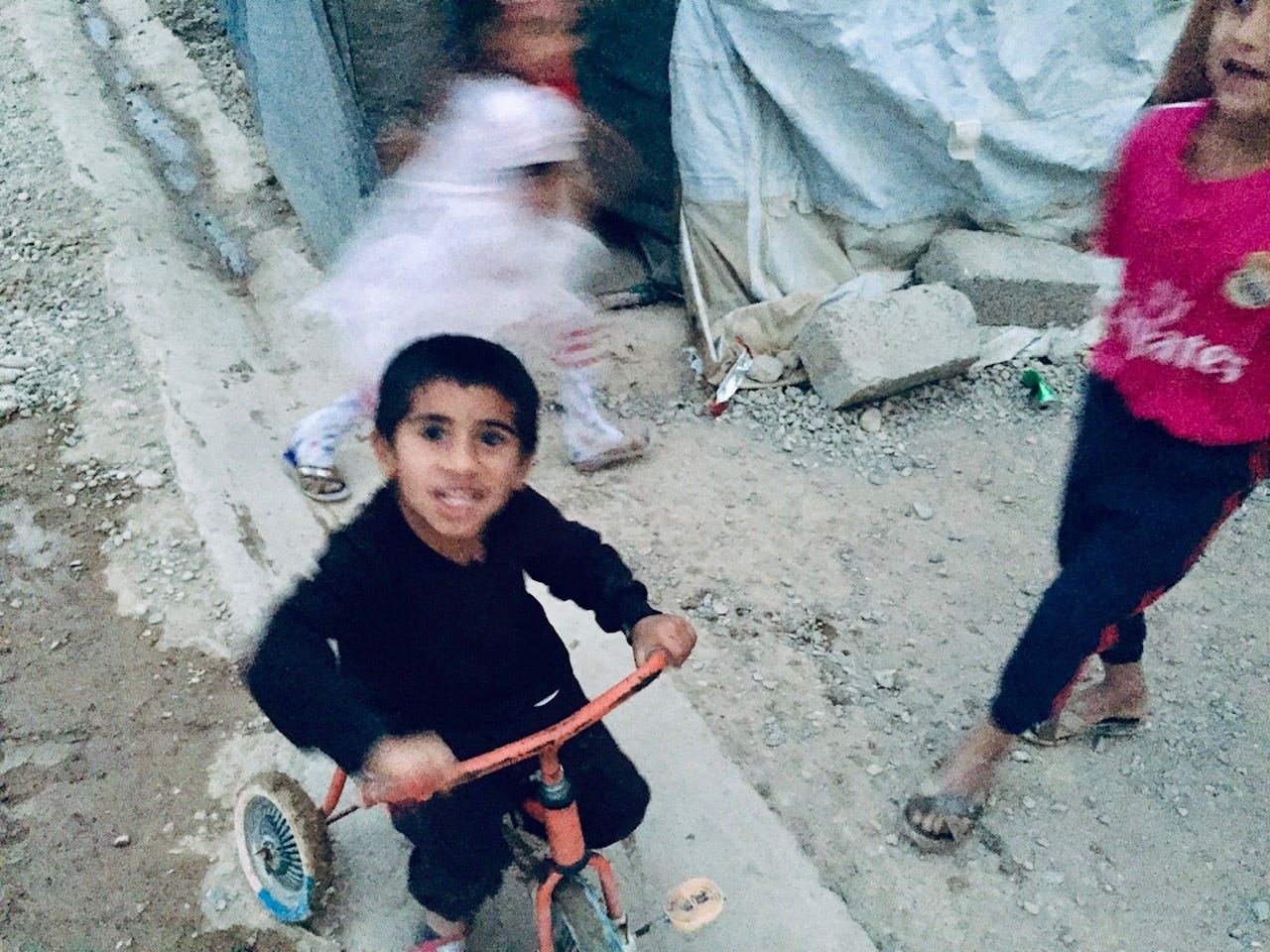
Confirmation bias plays a role in all of this. We seek out information that supports what we already believe and dismiss what doesn’t, often without realizing it. Distance plays a role too: the further removed we are from someone’s life or culture, the easier it is to see them as “other.” We sympathize fastest with people who look and live like us. Empires and armies have used exactly this mechanism to justify atrocities for as long as there’s been war.
Yet the same tools that deepen division from global communication to social media, can also close that divide, if we use them deliberately and carefully.
**
I don’t know what happened to Mirza. I don’t know if he ever found his wife or made peace with a world that priced her at $30,000 and then doubled the cost when he finally scraped it together. I think about him more than almost anyone I’ve met in fourteen countries of war.
If there’s an answer, maybe it’s just this: don’t look away. Mirza’s rain fell like any rain. His loss was as painful as anyone else’s. The lives of children, all children, matter.
The day we forget that, we’ve already lost the argument.
PLEASE CONSIDER A PAID SUBSCRIPTION TO HELP KEEP INDEPENDENT WRITING ALIVE :)
Excellent words, Hollie. Of all the many mistakes we made in the war on terror, going after ISIS to stop the Yazidi massacre was not one of them—our mistake was not stopping them soon enough. And then, what of those who were stolen and trafficked. Great article and powerful story.
"Somewhere, a man like Mirza becomes a footnote instead of a father." This line grabbed me by the throat.