

Last weekend, the night before I went into labor with my second child, I woke suddenly in a cold sweat, recalling the nights I had stood amid the wreckage of maternity wards bombed in the dark. I remembered, too, the mothers I had stood beside at the edge of mass graves, as their children were pulled from the depths of informal prisons. I found myself clawing through my office drawers for the notebooks where I had written it all down: every place I had swept through, the places where life begins and ends in the same exhalation.
As quickly as I felt myself falling apart, I pulled myself back together, soothed by the tiny foot I could tickle at the top of my abdomen, savoring what would be the final hours of just baby and me, two breathing souls as one. I cannot wait to meet her in the flesh, and to share her with our nearest and dearest, although I already know that a part of me will grieve the cocoon of just us.
I had almost forgotten the tremendous pull of childbirth’s undertow. What started as tempered waves that my husband Ryan and I giggled through rapidly built into cresting surges I sang through like a wannabe opera singer speaking in tongues, and very quickly into guttural moans that sounded more wounded wild animal than woman — my nails sinking into Ryan’s palm as I begged him and the tender-spoken midwife Ashleigh to help me.
That, almost always, is the transition: the crossing into the last stretch. At this point, you convince yourself that you are dying until some unspeakable higher power overtakes you, until the surreal becomes real and the wailing child you felt but never heard nor saw finally bursts earthside.
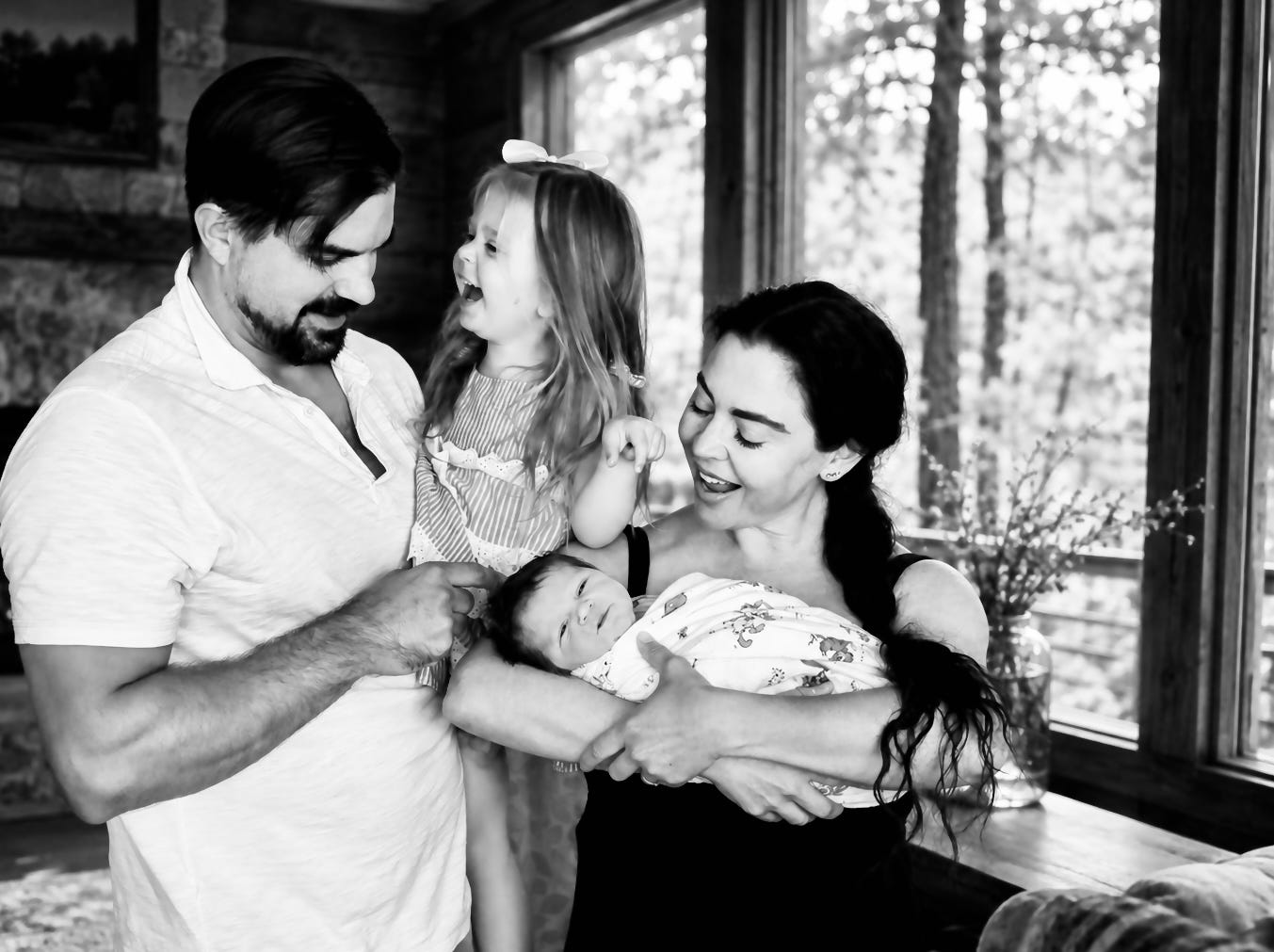
On the last day of summer in 2023, I came home from the wild of distant assignments and became a mother for the first time, to a baby girl, Raven Rita, who cracked me open in ways I could never have fathomed. This past Monday, on a perfect northern Virginia July afternoon, with sunlight spilling through the half-drawn blinds, my baby became a big sister.
Rumi Evelyn Rosa arrived earthside in a single push and was everything I had envisioned in that liminal space between sleep and awake. Rumi is our rainbow baby, yearned for long before she had a name.
Rumi’s name emanates from the 13th-century poet born in what is now Balkh Province, Afghanistan, whose words have quietly walked beside me through the hardest places: the rubble, the grief, the questions with no clean answers. Rumi’s timeless work, however, was never entrenched in darkness. He wrote about love, about holding on, and about finding the sacred inside ordinary days. Afghanistan lives in both Ryan’s bones and mine, and probably always will.
Roaming far-flung parts of the world toting a backpack stuffed with a flak jacket and notebooks with fraying edges and tear-smudged words, praying for a white light of protection, I longed for a little family more than I ever knew how to put into words. I feared, more than anything, that it would never happen.
It did.
Our girls are the best thing we have ever done, and the best we ever will do. Motherhood, for me, is the culmination of everything I have done right in my life: the seemingly wrong turns and poor decisions that all led me to this altar of pure right.
Yet, what I did not expect, going into this matrescence odyssey for the first time years ago, and what no amount of field reporting prepared me for, is the sheer statistical improbability of any of it. The miracle is not mystical. It is mathematical. The math, once you start digging, is staggering.
Our daughters remind me that life itself is the miracle — that you, I, and everyone sitting near you right now are proof of it.
The numbers that should not add up
In the waning days of this pregnancy, I dug up some facts: a woman is born with roughly 1 to 2 million eggs. By the time she reaches puberty, most of them are already gone. She will ovulate perhaps 400 times in her lifetime. A man produces around 525 billion sperm across his life, releasing roughly 200 to 500 million in a single act. Of those, only a few hundred will reach the fallopian tube. Only one will breach the egg.
The probability of any specific sperm fertilizing any specific egg is somewhere in the vicinity of one in 400 quadrillion, and that is before you account for the genetic lottery of what comes next.
Each human carries roughly 3.2 billion base pairs of DNA. When two people conceive, those base pairs recombine in ways that will never be repeated. An estimate widely cited by biologists puts the number of possible genetic combinations from a single couple at more than 70 trillion. That child, that precise arrangement of matter and memory and inherited sorrow, has never existed before and will never exist again.
You are one in 70 trillion possibilities. For you to be born at all, everything had to line up exactly, miraculously, right.
What has to go right
The egg must be viable. The sperm must be motile, morphologically sound, and fast enough. Fertilization must occur within a 12- to 24-hour window. The resulting embryo must successfully implant, and roughly half do not. The body must not miscarry, which it does in an estimated ten to twenty percent of known pregnancies, and far more in pregnancies that end before a woman even knows she has conceived.
The embryo must develop a beating heart by week six. The neural tube must close by week four. The lungs, the last organ to mature, must be ready by the time the world outside demands them.
Every cell division must replicate with fidelity across a body that begins as a single cell and ends up as 37 trillion cells.
The odds of a genetically normal embryo progressing to live birth have been estimated at 25-50 percent per cycle under the most favorable conditions for the most reproductively healthy people. For most women, in most circumstances, across most of human history, the numbers have been far worse.
What I keep thinking about
On top of this, I am all too aware that in many pockets of this planet, giving birth is the most dangerous thing a woman can do. The World Health Organization and its UN partners estimate that a woman dies every two minutes from causes related to pregnancy or childbirth. Where the safeguards, the trained personnel, and the basic tools to keep mother and child alive do not exist.
The miracle, I have come to understand, was never in the rarity of a heartbeat. It is in the persistence — that against every one of these odds, against every peril stacked in its way, something as singular and unrepeatable as a human being keeps finding its way into the world. Still arriving. Still opening its eyes for the first time.
My newborn daughter, swaddled in a soft cloth dotted with baby chicks and sleeping soundly in our sun room, does not know any of this yet. Rumi only knows hunger, warmth, the sound of my voice, the scent of my skin, and the taste of sweet breastmilk.
But I know. And I find I cannot stop counting the ways she should not exist, and marveling, still, that she exists at all — that both my children do, and that I do, too.
I have spent my life documenting what the world takes. This is what it gives back. What an astonishing privilege, to be alive for it.
Fabulously articulated. Wish all the best always.
May the blessings on you and yours be endless, well written.