

In September 2021, a few weeks after the Taliban took Kabul, my photographer Jake and I (and our wonderful fixer Naweed) talked our way into a former nursery school in the Afghan capital. Here is what I found inside.
“Are you American?” a Taliban fighter sneers through a wedge in the front gate, his rifle semi-raised beside him.
“Australian,” Naweed, our Afghan fixer/interpreter quickly informs them.
“Okay,” he responds slowly. “If you were American we would shoot you.”
The on-guard fighter gestures us inside, and I shuffle forward, wincing as the gate clicks locked behind me, wondering if I should turn around. Curiousity propels me forward.
Stuffed toys sit abandoned on a shelf near the entrance. The playground equipment is still, and Taliban uniforms are hung to dry over the playpen fence. They are stark reminders of the nursery school that operated inside these faded pink walls just 10 days earlier.
The former school is now the base of the Taliban’s elite special forces unit, known as Badri 313 or the “Badri Command.” It houses the hardest of the hard fighters, who roam the grounds in camouflage carrying American-made weapons. It also houses the men training to become suicide bombers, or “martyrdom” bombers as they call it.
“This Command has two parts,” a high-ranking fighter tells me in a low voice. I later learn his name is Hafiz Badri.
“There are those who train to be special forces fighters and those who train to be special suicide bombers,” he continues nonchalently, as if comparing a game of soccer to basketball.
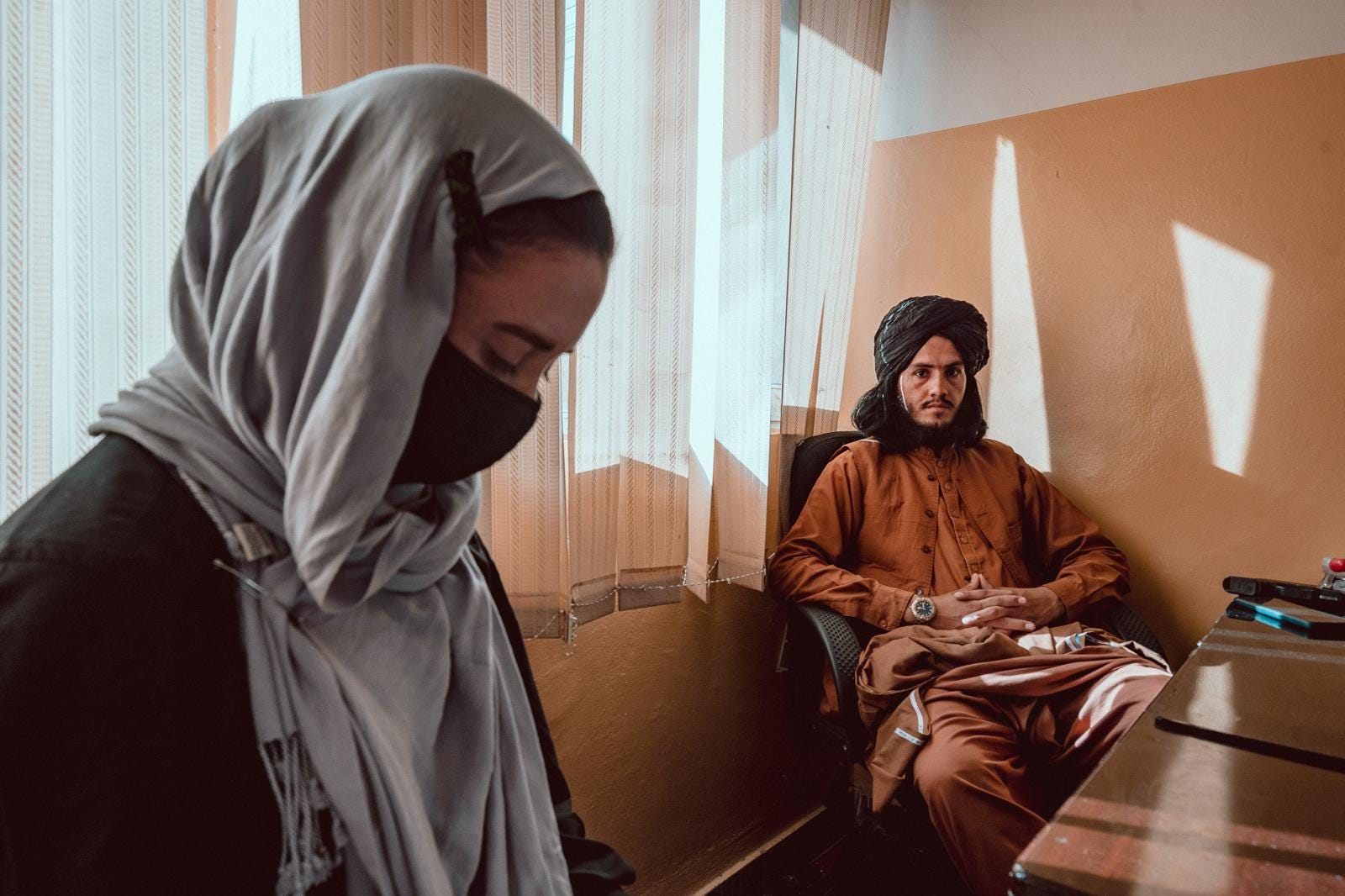
After some back-and-forth, the senior unit leader, an older man eyeing us suspiciously from his cross-legged position on the concrete, agrees to let us inside. We walk along cracked concrete paths where children played only days before. Then we enter a small office with little more than plastic chairs and a wooden desk, sun peaking through the closed blinds, where an American M240 machine gun is proudly hoisted, with belts of ammunition ready beside it.
Slightly uncomfortable, is all my mind can think to internally churn. But so much of this work routinely hinges on the somewhat unordinary.
“We Just Got the Guns and Got Started”
The battalion is heavily equipped with state-of-the-art American gear: camouflage uniforms, body armor, Humvees, night-vision goggles, M4 carbines and M16 rifles. For sidearms, the men carry shiny new Glocks and 1911 pistols.
“We don’t have official training when we join the Taliban,” Badri, 29, a native of Helmand Province, says with a laugh when I ask about their “preparation.” “We just got the guns and got started.”
He explains that a fighter must first “have done special actions designed for this command” before being picked for training.
The suicide squad has no shortage of volunteers. Badri and another senior fighter, Kari Omadi Abdullah, 26, agree they are overwhelmed by men wanting to join its ranks.
“It is not about the picking in this case. It is about the eagerness,” Badri chimes in enthusiastically. “There are some fighters who even come to us crying and begging, asking why we don’t pick them for the suicide squad.”
The men explain that training lasts anywhere from 40 days to six months, depending on the mission. It combines intensive tactical work with religious study.
Most recruits come from poor families and have little education. Some have been arrested by Afghan intelligence before they could carry out attacks. Past recruits have described training that included firing rifles in the mountains, but they say most of it came down to spiritual preparation and total commitment to the cause.
In 2017, I interviewed a trained suicide bomber in Afghanistan who had been ordered, at just 17, to attack the German consulate in the northern city of Mazar-e-Sharif in late 2016. He passed out and couldn’t go through with it. The rest of the attack team killed some six people and wounded more than 100. He told me he trained near the Pakistan border. The first weeks “of school” were mostly Islamic teaching, followed by weapons training and physical exercise.
“Our Schools Are Filled With Fighters”
The fighters proudly tell me that the unit is named for the Battle of Badr some 1,400 years ago, when the Prophet Muhammad’s army of 313 defeated a much larger Quraysh force. The squad is also said to be closely tied to the Haqqani network, which is allied with al-Qaeda. The Haqqanis have long celebrated the exploits of the “Badri Army,” which suggests the two are one and the same.
Estimates put the group at hundreds, if not thousands, of highly trained, battle-hardened fighters. Badri tells me there are around 300 Special Forces in and around Kabul.
“Our schools are filled with fighters,” Omari continues.
The men point out that the average Badri fighter is between 25 and 30 years old. The suicide bombers are usually 20 or older.
Over the past decade, suicide missions became a staple of the Taliban insurgency. They were a way to spread fear and, eventually, to take the country. Blowing oneself up in the name of martyrdom is viewed as a revered act. Even the son of the Taliban’s Supreme Leader, Haibatullah Akhundzada, is reported to have been a suicide bomber.
Suicide attacks became commonplace after NATO’s combat mission ended at the close of 2014. (It then downsized into “Resolute Support,” a supposed non-combat mission to train, advise and assist Afghan security forces, and it lasted until the withdrawal in 2021.)
Despite the mission change, the carnage was relentless, and it chiefly targeted Afghan security forces. In recent years, the Taliban have claimed or been suspected of attacks on police stations, Shia neighborhoods at Kabul rush hour and an Afghan election office. Most recently, they struck outside the residence of then-acting Defense Minister Bismillah Khan Mohammadi, killing eight people just 12 days before they took the capital.
When Kabul fell in mid-August, the Taliban boasted that Badri 313 quickly secured the presidential palace and later took control of the area around Kabul’s airport during the chaotic American exit. Badri fighters even mocked the United States on social media. They recreated the famous 1945 photo of Marines raising the American flag on Iwo Jima, this time with themselves raising the white-and-black Taliban flag.
“We Are Training on These to Show the World”
Since taking Kabul, the men underscore, they have been flooded with requests to join.
“We have unlimited recruits. If we capture one thief, 40 people then come to collect our numbers to join, too,” Omari boasts. He adds that they accept foreigners.
The fighters now talk about “peace” in the country they’ve conquered, but there is no sign the suicide school will close. The men make clear that their next focus is heavy weaponry and building up an air force.
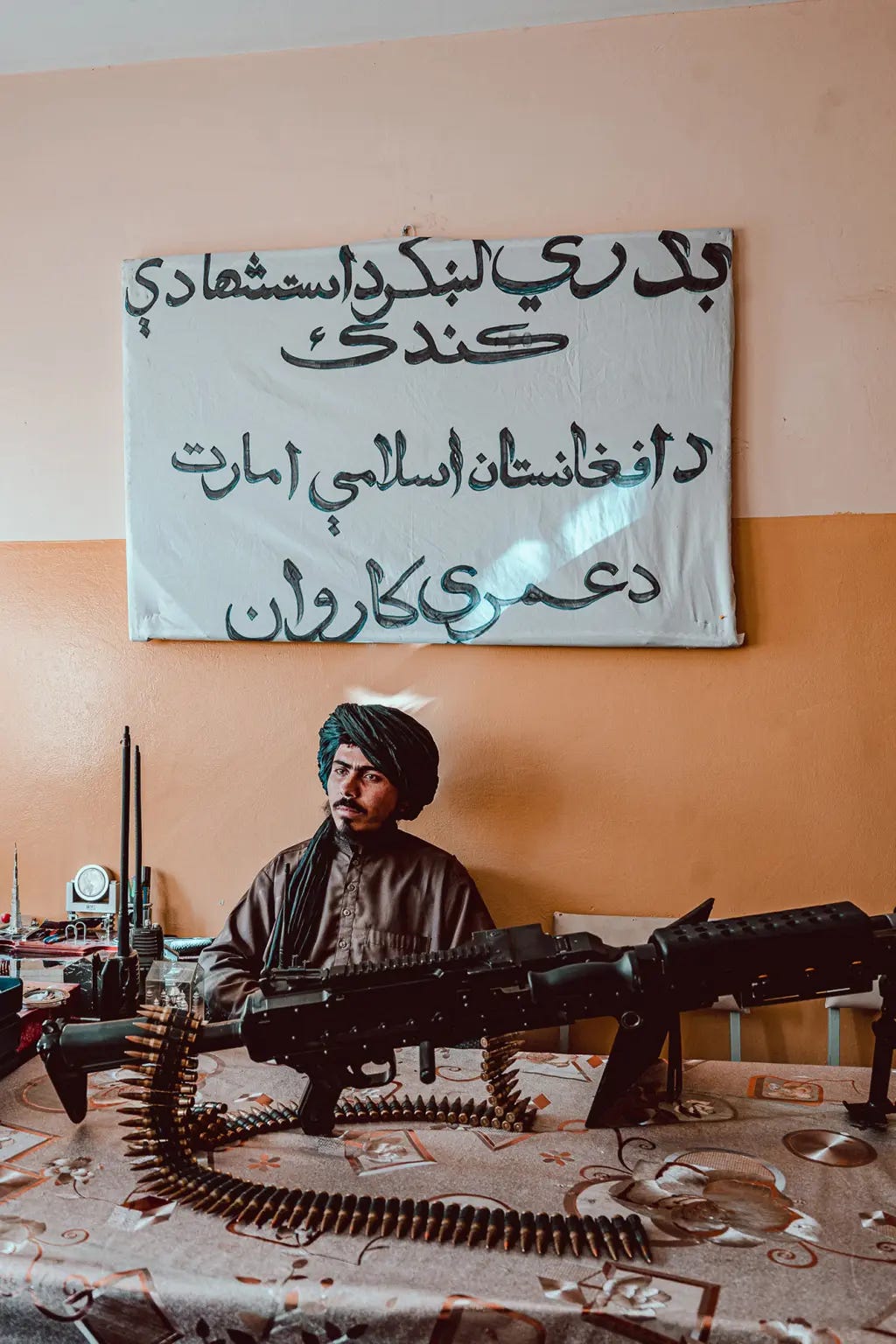
(credit Jake Simkin)
“We are going to be concentrating our training on the big arms, as well as the helicopters, jets, whatever is available,” Omari emphasizes. “We are training on these to show the world that we can do it.”
The Taliban’s new arsenal came courtesy of the collapsed Afghan forces. It includes light attack aircraft and helicopters, among them dozens of American UH-60 Black Hawks, Cessna Combat Caravans, possibly C-130 Hercules transports and at least 12 Pilatus PC-12 surveillance planes.
As I continue to extract details of the selection process, and press on the issue of how early the indoctrination process lasts, I hear a sharp rebuke at the door. The commander, the one that was on the floor, barks that it is enough now. The fighter swivels the machine gun an inch or two.
“The tea is ready,” the commander says sharply.
Outside, on the grounds of the former school, fighters gather around a picnic rug with their rifles. Some wear turbans and sandals with their camouflage and have beards and long hair. Others look as though they once served in the Afghan or even the American army, with fresh stubble, hard jawlines and tightly laced combat boots. An American “Danger” sticker is still on the back of their armored truck.
Afghan hospitality can be a strange thing, yet even the Talibs scramble together what they can to “honor” a guest. I politely take the small glass of green tea, unable to bring myself to real sip. Suddenly, there is a commotion. Fighters from the shadowy squad are summoned into the back of their (evidently American) truck.
“Do you want to come to Pakitika? We are going now,” Hafiz declares. “We need to take care of…”
Naweed stares at me unblinking, and somehow, Jake and I manage enough sanity to decline and depart, moving out into the warm day. I turn one last time to look at that training school, a place once occupied by the giggling and innocent.
Of course, this omnious base looks like nothing from outside. It is protected only by chipped lemon-yellow walls covered in graffiti. Children push carts of spices and slabs of meat to and from the nearby market. Men pedal rusty bikes along the cobblestones without a second glance.
No one seems to know about the secret squad inside. If they do, they don’t seem alarmed, only sad.
“It used to have a beautiful park next door,” one onlooker says wistfully. “Now we stay inside.”
Ironically, today, most of the suicide bomb attacks are carried out by insurgent groups like ISIS and the opposing Pakistani Taliban (TTP) against Afghanistan’s Taliban, formally the Islamic Emirate. However, the Taliban has become the only government in modern times to overtly build suicide battalions into its national army, before saying in 2024 that it had folded them into its special forces.
It marks the first time since World War II that a national army had formally included suicide units. Unlike Japan’s kamikazes, the Taliban created theirs after they had already claimed victory.
A good friend’s text message lights up my screen as I hop into the back of a cab. She is checking if I am okay, sending pictures of her new kitten, lamenting a brief romance and unexpected breakup.
“What are you doing?” she then asks.
“Well I just left a -
I pause. Nevermind.
“Going to get coffee now,” is all I write.
PLEASE CONSIDER A PAID SUBSCRIPTION TO KEEP INDIE JOURNALISM ALIVE.
Brave work
Hollie, you have a way with words!