

One spring afternoon in 2018, soldiers drive me down a narrow-rutted track toward a rundown building on the outskirts of Yemen’s capital, Sana’a.
A smattering of young boys hobbles silently under the sweltering afternoon sun. Each one is missing a vital body part: a hand, a leg, an arm. Each possesses a timeless quality, as if they’re suspended in time at the moment their bodies were changed. Still, the dust drifts in the receding light. Still, far away, the ocean continues to roll onto the shore. Few will ever know what these children have survived.
“Sometimes I go to my office to cry for each of these miserable stories,” says Dr. Haitham Ahmed Ali Ahmed, a Sudanese volunteer with Physicians Across Continents. “It isn’t fair, but we do whatever we can to give them another chance.”
I try to convince myself that inside that building, they are reshaping hope: prosthetic limbs cut, carved, melted, and molded. Only it’s the children teaching other children the woodwork. The loss of limbs has become an all-too-common occurrence in a country battered by years of bloodshed. As the war rages, the demand for artificial limbs rises by the day. Though some on-site factories in Yemen have adopted newer technologies, outdated materials still dominate — forcing even small boys to wear heavy, barely functional prosthetics.
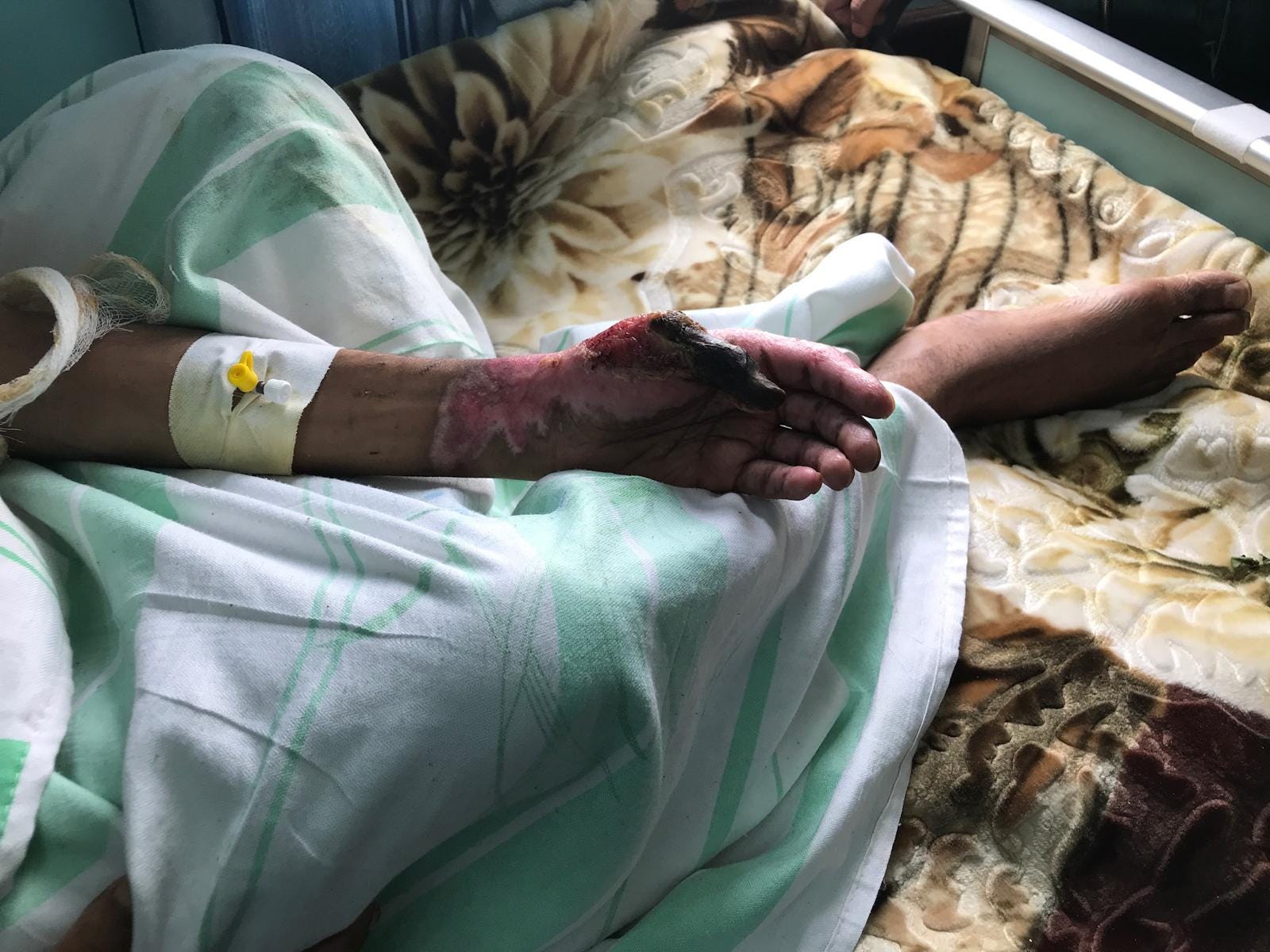
Many human rights groups and international observers have accused the Saudi-led coalition of indiscriminate airstrikes. The opposing Houthis have also been blamed for arbitrary shelling and scattering the land with mines, leaving behind a deadly legacy that will endanger Yemenis for generations.
“Sixty percent of the cases are due to mines,” Dr. Haitham explains. “Thirty percent from road accidents, and the rest mostly from gunshots.”
The war in Yemen, which began in earnest in 2015, is a complex conflict fueled by internal political strife, regional power struggles, and a widening humanitarian catastrophe. At its core, the war pits the Houthi movement — a Zaidi Shia rebel group from northern Yemen with ties to Iran — against the internationally recognized Yemeni government, which is backed by a Saudi-led military coalition.
Yemen was already coming apart before anyone called it a war. Decades of political dysfunction, an economy that never quite held, and then 2011, when the Arab Spring pushed Ali Abdullah Saleh out after thirty-plus years of keeping the lid on. His successor, Abdrabbuh Mansur Hadi, struggled to govern, and in 2014, the Houthis capitalized on the political vacuum by seizing the capital, Sana’a.
Saudi Arabia moved in March 2015. The prospect of an Iran-backed militia consolidating control along its southern border was not something Riyadh was prepared to absorb. A coalition of Arab states went in behind them, backing what remained of the Hadi government. What followed has been years of airstrikes, ground fighting, and shifting alliances, including a temporary partnership between former President Saleh and the Houthis before he was killed in 2017.
Beyond the regional proxy dynamics between Iran and Saudi Arabia, the war has fractured Yemen along tribal, sectarian, and ideological lines, drawing in separatist factions, Islamist groups, and local militias. The result has been one of the world’s worst humanitarian crises — tens of thousands killed, millions displaced, and widespread famine and disease.
The United States has played a complex and controversial role, providing logistical support, intelligence, and arms sales to the Saudi coalition for much of the conflict. Critics argue that this backing fueled civilian casualties and prolonged the war.
Geopolitics, however, is for those far away in gilded offices. Civilians caught in the crossfire don’t have the luxury of weighing such policy debates. I find myself asking: where are the girls, the women, the mothers to these boys? Are they being cared for? Are they getting the medical help they need?
Later that day, at my insistence, Yemeni soldiers transport me to a private home where others in need wait behind closed doors for medical care. Behind a gray curtain, hidden from the male gaze, a small group of mothers and daughters sit on a cold concrete floor, waiting for the elusive day when they, too, will be fitted with prosthetics, or take their first uneasy steps to the stiff, unforgiving clunk of wood. Assistive devices are scarce in Yemen, and those available are often ill-fitting or unsuitable for the rugged terrain of displacement camps.
Scores of Yemeni civilians, caught in the merciless volley, now live with permanent disabilities. Most aren’t even on a waitlist for treatment. For the poorest and most abandoned, an artificial limb is a distant dream, a luxury reserved for another world.
Women and girls are usually the last to receive treatment. People often say it’s more important to prioritize boys and men so they can “go out and provide.” Even then, many men struggle to find work, to care for families, and to avoid becoming burdens to those who love them, as the label of disability follows them at every turn.
While women in Yemen may not be explicitly deprioritized for prosthetics, a range of factors — limited resources, cultural norms, and logistical challenges — impede their access to these essential medical tools.
In the corner, shielded by a black burqa, a blind mother breastfeeds her baby with one arm. Birth here isn’t only about the child. It’s about what the woman becomes in the process. She doesn’t linger on what she lacks. When I ask, carefully, about the difficulty of her situation, she tilts her head in a way that answers before she speaks. What other choice is there?
This mother is everything I envision when I hear the phrase mama bear: an ardently gentle goddess — protective, resolute. The legendary midwife Ina May Gaskin once wrote in her seminal book Spiritual Midwifery, “When a child is born, the entire Universe has to shift and make room.”
I have come to believe the same is true of mothers. They become larger versions of themselves — more realized, more powerful, a more potent presence in a society that seeks to marginalize them. They transform into healers and warriors. Their footprints grow bigger. Their hands grow featherlight and ferocious, both at once.
Could I ever live up to such unrecognized heroism?
That night, back in my small room in a concrete compound under routine artillery fire, I scrawl notes furiously in preparation for an appearance on American television. The bombings. The war. The lost limbs. The mothers. All the things that do not hit the headlines.
A few minutes before airtime, the producers bump me for Lara Trump.
PLEASE HELP KEEP INDIE WRITING AND REPORTING ALIVE WITH A PAID SUBSCRIPTION. THANK YOU SO MUCH FOR YOUR SUPPORT xo
Another excellent, profound piece of work. Well done Hollie