

Every morning during a work stint in Afghanistan almost a decade ago, I would pass a bakery window painted lime green in the heart of Kabul, and a gentle blue-eyed boy named Abdul would shyly wave. He was around 14 years old. Abdul would peer out from behind the racks of warm naan, watching the street. One morning, I saw two government officials (in the days before the Taliban return) stop by the bakery, talk intently to his uncle, and then climb back into their vehicle, a vehicle funded largely by the American taxpayer in the war effort, and drive away.
As I then approached, Abdul appeared terrified; the color drained from his once rosy cheeks, and his oceanic eyes as wide as saucers. The next morning when I passed by, he was not there. Then the next morning, and the next. Eventually, I approached his uncle. Slumped forward in defeat, he told me that a powerful official had taken him away to “provide him with a better income.”
I knew, he knew, we all knew what that meant. I went home and wept for that young boy whom I did not know beyond his smile and wave, feeling sick and helpless. Those frightened eyes have never left me.
It was evident that Abdul had become a victim of bacha bazi, a term in Dari that translates as “boy play.” It is a practice in which boys, generally between the ages of 10 and 18, are dressed in women’s clothing, made up with cosmetics, forced to dance at private gatherings of powerful men, and then sexually abused. The perpetrators are warlords, militia commanders, police chiefs, government officials and wealthy businessmen. The victims are typically the poorest and most invisible children in the country.
A practice older than the state
War in the past two decades did not lead to bacha bazi. This practice dates back centuries, to the court cultures of Central Asia and Persia, where dancing boys entertained emirs and khans and were romanticized in poetry and miniature paintings. During the imperial era, Russian administrators documented it throughout western Turkistan, and it persisted until Moscow stamped it out north of the Amu Darya. Nobody, however, ever did so south of the river.
The men, however, who do this do not consider themselves homosexual, a label that carries a death sentence in Afghanistan. In their eyes, the boys are not partners. They are possessions. The religious cover does not hold either, since Islamic scholars have condemned the practice over and over. What lies behind the word ‘tradition’ is really just impunity.
The Taliban brutally suppressed bacha bazi during their first regime in the 1990s, one of the few acts for which ordinary Afghans gave them grudging credit. Then came 2001, and with it the return of the warlords and strongmen the United States empowered to fight our war. Bacha bazi roared back, flourishing in police barracks and district compounds bankrolled, however indirectly, by American taxpayers.
Boys are lured by promises of work as tea boys or apprentices, or school fees for families that cannot afford them. For some, nothing more than the offer of regular meals will suffice. Others are snatched, or their families are threatened outright. Very occasionally, families do sell their sons — usually those crushed by debt, including drug-related debt — though predators have little incentive to pay for what hunger will deliver freely.
There is no single arrangement after that: one boy might stay with the same patron for years, kept close as proof of the man’s standing, another gets hired out to dance at weddings and private parties, and another is passed from one man to the next as the novelty wears off. There is no ledger for any of this, and no one who can say who brokers the transfers or what a child actually costs.
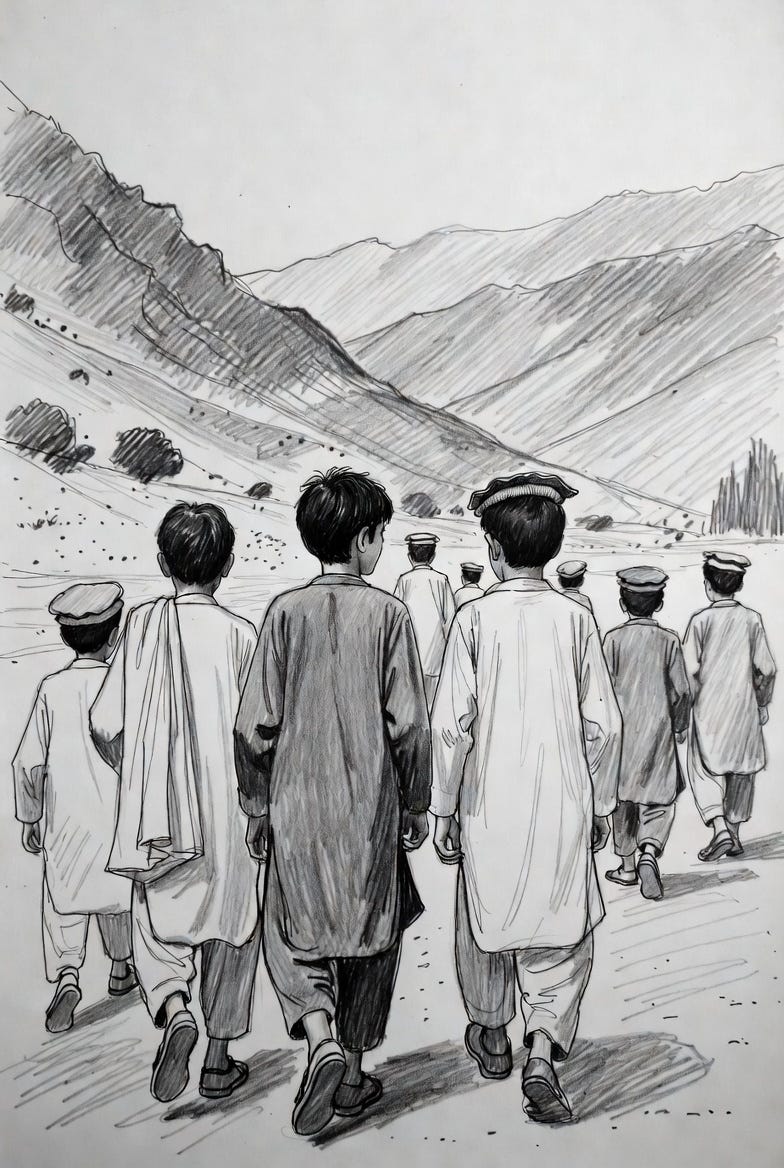
He is turned out, usually before he is 20, often with no education and a disgrace that rightly belongs to other men. The survivors who have spoken to researchers tend to give the same accounts. They fall into drug addiction and begging in and around home villages that will not take them back. Chillingly, some of those discarded boys grow up and seek out boys of their own, which is how the practice feeds itself.
The cruelest twist sits in the law itself. Under the former republic and under the Taliban, a boy who reports his own rape can be punished for a so-called moral crime.
Here’s what keeps me up: for 20 years, the United States had the power to confront bacha bazi. We, the supposed champions of freedom and justice, had a rare chance to give those children a reason to hope. However, our leaders, under multiple administrations, both Republican and Democrat, instead chose the path of least resistance and hid behind the comfortable lie of cultural relativism. Sure, I understand there is mission creep, and then there is downright pedophilia and abuse that is wrong and twisted no matter where on the planet it happens.
Our leaders even went so far as to punish U.S. military personnel who stood up to this barbarity.
In 2011, in Kunduz province, Army Special Forces soldiers learned that a local police commander they had helped train had kept a boy chained to his bed as a bacha bazi sex slave, raping him repeatedly while the boy’s mother was beaten when she sought the Americans’ help. Sergeant First Class Charles Martland and his team leader, Captain Dan Quinn, confronted the commander and beat him. They did not kill or seriously wound him, but they taught him the lesson that this would not be tolerated.
The U.S. military response? Captain Quinn was relieved of his command and resigned his commission. When the case became public in 2015, the Army moved to forcibly retire Sergeant Martland too. Only after a wave of public outcry and pressure from lawmakers did the Army reverse course in 2016 and allow him to stay in uniform.
Sometimes it takes a zero-tolerance approach to stop the bleeding.
Someone recently reminded me of sati, the centuries-old practice in India of burning widows alive on their husbands’ funeral pyres. That, too, was defended as sacred tradition, woven into faith and custom, untouchable by outsiders. Yet it ended, in large part, because the British colonial authorities outlawed it in 1829 and made clear that any man who took part would face the gallows, with Indian reformers pushing just as hard from within.
Some traditions deserve to die, and history shows they can be killed when those with power decide the cost of tolerating them is too high.
The Taliban claim to have banned bacha bazi once again, and have even issued a formal decree against human trafficking. The State Department’s 2025 trafficking report suggests the decree is not worth the paper it is printed on. Afghanistan sits on the lowest tier. Observers found a continuing pattern of boys held in sexual slavery and identified Taliban members among the perpetrators. The regime, for its part, could not point to a single investigation, prosecution, for protected victim. Behind closed doors, the practice carries on as it always has.
I think often of that empty bakery window. At one point we had a hundred thousand troops in that country, the most powerful military on earth.
So who, I keep asking myself, will protect the next vulnerable boy?
PLEASE CONSIDER A PAID SUBSCRIPTION TO HELP KEEP INDEPENDENT WRITING ALIVE. “MATERNAL DISPATCHES” ALSO HAS A PODCAST, AVAILABLE WHEREVER YOU GET YOUR PODCASTS!
What struck me most is that this story is not ultimately about culture or tradition; it is about power. Throughout history, harmful practices have often survived not because ordinary people supported them, but because powerful people benefited from them and institutions refused to challenge them.
Bacha bazi exposes a painful sociological truth: when a society is fractured by war, poverty, weak institutions, and impunity, the most vulnerable children can become commodities rather than citizens. In that context, the language of “tradition” functions less as an explanation and more as a shield protecting those who hold power.
What makes Abdul’s story so haunting is that exploitation is rarely invisible. People often know. Communities often know. Authorities often know. The real question is why some lives are considered expendable enough that knowing does not lead to action.
Ultimately, a society should be judged not by how it treats its most powerful members, but by how fiercely it protects those with the least power to protect themselves.
It is horrendous how we hide behind “tradition” on what is basically rape and sexual slavery and how we use that same logic when - as you have pointed out - fathers selling their daughters or on other issues like female genital mutilation.