

Long before becoming a mom, I had a dream about taking my future daughter to Marrakesh, the spirtual center of Morocco. I carried the vision with me through the blur of airports and conflict zones, through years of heartbreak and deadlines — the secret promise of a place where time might finally feel still, where the earth itself might remind me how to breathe again.
Here we were on a long ago planned North African expedition, hand in hand, weaving through cumin, rose petals dried and ground into powders of pink. Leather and smoke mingled with the call to prayer rising from minarets. Somewhere in the background, a chorus of children’s laughter broke against the clatter of donkey hooves.
Marrakesh is not merely a city. It is an act of immersion. The scents, the sounds, the colors; they do not politely invite you in, they pull you under. It is at once chaotic and deeply spiritual, a place that reminds you how small and how infinite we are in the same breath.
I had waited my whole life to arrive here. Yet when I finally did, I realized how much of me wasn’t here at all.
I kept reaching for my phone. Refreshing news feeds. Looking for news updates, scrolling through missed calls and the opportunities that might vanish if I didn’t respond fast enough. Even in the shadow of ancient mosques and gardens older than memory, I was trapped in a vortex that tethered me to another world.
Behind every doorway, Marrakesh offered something to slow me down: a lantern shop flickering with brass cutouts, an elderly woman threading beads in silence, the Secret Garden unfurling its quiet symphony of green amid the dust. Still, my mind churned with endless financial, career and personal health worries, and the realization that I have been doing this work since I was nineteen, and it is all I have ever known and loved. Is there anything else can I do to be a better support system for those I love?

It seemed selfish to dwell on my burdens, so small and solvable compared to the heartbreaks I have witnessed in other corners of the world. Yet each of us wages silent wars, unseen. Mine had begun to erode my ability to connect with anything in front of me — even with my daughter’s laughter as she tugged me toward the large fountain screeching excitedly that it was time to “wash hands.”
It was in the old madrassa, sunlight pouring through carved archways, that the breaking came. I felt my body collapse into sobs I could not contain, hadn’t even sensed were waiting. The surrender was sudden and undeniable. I started, very slowly, to sift through the weeds for the faith that glues the world together when it teeters on breaking into a million pieces.
I took off my FitBit and discarded it for good. I need to stand still in the world much more than I need to track steps. I turned the phone off completely and slid it into the bottom of my bag as though it were an artifact I might not need again. At first, the silence was unbearable.
Then, minute by minute, I began to feel my body re-calibrate; the constant hum of fight-or-flight softening to a quieter, steadier rhythm. In the disconnect, and only in the disconnect, I started to let go.
Walking through the Old Medina afterward, where there are no cars and only feet and scooters and horse-drawn carts, I noticed how colors burned sharper. How the warmth of the Moroccan sun lingered on my skin like a balm. How my daughter’s small hand gripped mine, grounding me. For the first time in so long, I was not living in a state of reaction but in a state of presence.
We went out into the desert at dusk. The city unraveled into sand and sky, a silence so vast it was almost a sound. Riding camels beneath a horizon stained in pink and gold, I realized I had been starving for this — for separation from scrolling and technology, which was in fact a deeper connection. With no signal, no cell towers, no chance of breaking the spell with an update or a notification, the desert became both mirror and medicine.
In that emptiness, empathy finds its primary place again. Not just for my own weary heart, but for the strangers whose lives flickered briefly into mine — our camel guide with his sand-worn hands, the woman who poured us mint tea, the children chasing kites against the wind. I remembered what it meant to care, not out of obligation or performative urgency, but simply because we are human and we belong to each other, to community, to something bigger than ourselves.
Something in my life, and in the lives of so many, must change. We cannot keep running ourselves into the ground with the constant drip of inflammatory algorithms, information, the daily alarms of news cycles, the economic pressures that leave us afraid to exhale. We cannot keep parenting from a place of depletion, creating from a place of exhaustion, loving from a place of distraction.
Logging off is not an escape. It is an act of reclamation. I don’t want to climb ladders and puncture glass ceilings. I want to curl into bed with my baby girl and a book and sip tea and sleep.

The world will not stop turning when we put the phone away. The tragedies will still unfold. The opportunities will still be there, or they will not. However, when we choose to step away, we create a chance to recover what is sacred: our attention, our presence, our capacity for wonder.
In Marrakesh, that wonder lives in every corner. It is in the smoke spiraling from street-side tagines. In the calloused palms of craftsmen hammering copper in dim-lit stalls. In the prayer whispered by an old man as he washes his hands before entering the mosque.
However, wonder also lives in my almost two-year-old daughter’s face, upturned to the sky. It lives in the way she pulls my face down and signals in sign language for more bunny kisses, the way she urges me to look at the world through her unfiltered eyes where something as simple as an old upholstered chair in the souk is a source of endless excitement. Marrakesh simply reminded me what I already knew yet had forgotten: that life happens in the unscrolled, unscripted spaces.
We are each fighting battles no one else can see. Yours are likely very different to mine. Yet beneath it all, I believe many of us are fighting the same war: the war against disconnection, against the erosion of empathy, against a way of living that leaves us always reacting and never arriving.
I do not know when or even if I will ever solve many of the dilemmas that keep me up at night. But I do know this: I cannot solve anything if I am not present for my own life.

And so, I will keep trying to log off. To lose myself in the deserts and gardens, to notice the small things, to weep when I need to and laugh when I can. To live with my child and husband not just in the safety of our routines, but in the splendor of experiences we will all carry long after memory begins to fray.
Marrakesh gave me that gift, and it is one I will spend the rest of my life trying to honor. Something in our cheap dopamine-hungry lives must give.
FOR EXCLUSIVE GLOBAL CONTENT AND DIRECT MESSAGING, PLEASE CONSIDER A PAID SUBSCRIPTION TO THIS SUBSTACK TO HELP KEEP INDEPENDENT, AGENDA-FREE WRITING AND JOURNALISM ALIVE. THANK YOU SO MUCH FOR YOUR SUPPORT.
For speaking queries please contact meta@metaspeakers.org
For ghostwriting, personalized mentoring or other writing/work-related queries please contact hollie@holliemckay.com
Follow me on Instagram and Twitter for more updates
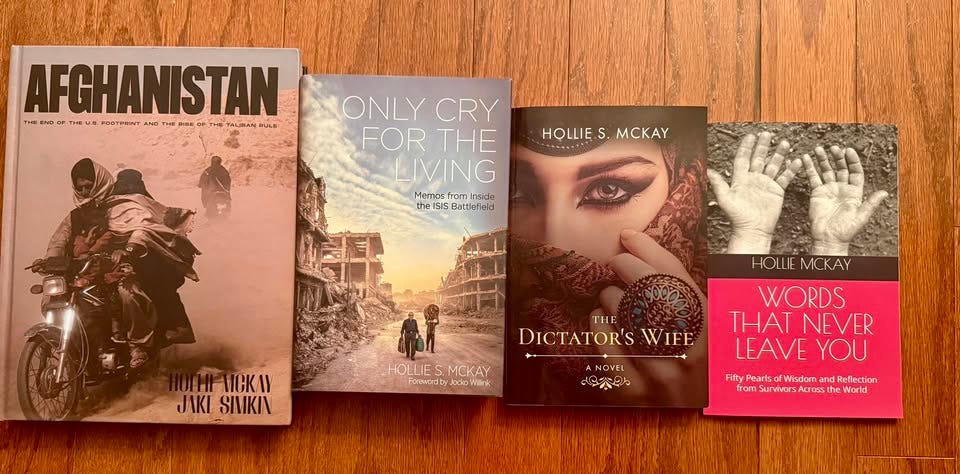
Click to Purchase All Books Here
Jesus famously said, "Unless you become like children, you will never enter the kingdom of heaven". As I strive to maintain my sense of wonder in the beauty of nature, my simple faith that there is a good God, and know what things are too heavy for me to carry and let them go, I find peace and rest in the midst of a crazy world. Another thing about children is that they have no natural prejudices. Those are taught. We need to reclaim our original love for all those made in the image of God.