

I can still see the tiny body; skin like paper, limbs too small for the weight of such violence — lying in the rubble as smoke and dust filled the air. The nightmares of that Yemen haven’t left me. I don’t want them to. Because when they do, I fear I will have lost something essential: my conscience.
There are few truths as self-evident as this: killing babies is wrong. Across cultures, faiths, and political systems, the protection of infants is regarded as one of humanity’s most basic moral obligations. Yet when it comes to war, international law takes a much murkier view. The killing of children, even infants, is tolerated, excused, and rationalized under the laws of armed conflict.
This is not to say that international law encourages the targeting of children. It does not. The Geneva Conventions and their additional protocols prohibit direct attacks on civilians. But here’s the catch: babies, like all civilians, are often reduced to “collateral damage.” If a military commander can argue that an attack was proportionate to the intended military advantage, the deaths of children, even dozens of them, can be deemed lawful.
That is the brutal arithmetic of war: infants, who are the very embodiment of innocence, become acceptable losses.
This is not an abstract problem. In recent years, wars from Gaza to Sudan to Ukraine have offered devastating proof of just how little protection international law provides the youngest and most vulnerable. When hospitals are bombed, when apartment buildings collapse, when refugee camps are shelled, it is children who suffocate under the rubble. Military lawyers then step in to explain that as long as a “legitimate target” was nearby, such deaths fall within the law.
Imagine explaining that to a mother holding her dead baby.
The flaw lies not only in how the laws are applied but in how they are designed. The principle of “proportionality” was drafted in an era when war was imagined as armies meeting on battlefields, not missiles striking apartment towers or drones hovering over playgrounds. Proportionality asks whether civilian casualties are excessive compared to the anticipated military gain. But who decides what is “excessive”? Almost always, it is the same military carrying out the attack.
As a result, the standard bends with political will. When powerful nations want to justify civilian casualties, they point to proportionality. When they want to condemn their adversaries, they cite war crimes. The law itself becomes a weapon of convenience.
Some defenders of the system argue that the laws of war are not meant to abolish civilian deaths, only to limit them. But that is a morally bankrupt position when it comes to babies. If international law cannot draw a red line around the deliberate or foreseeable killing of infants, what claim does it have to moral authority at all?
Consider how international courts have struggled with this issue. Prosecutions for war crimes rarely hinge on the killing of children unless those children were explicitly targeted. A bomb that wipes out a nursery inside a residential block is not necessarily illegal if there was a military office on another floor. The law does not ask whether the commander could have chosen another method, or whether the lives of infants carry unique weight. It simply tallies deaths against military necessity.

The absurdity becomes clear when we look at other areas of international law. Chemical weapons are banned outright; not because they kill more people than conventional bombs, but because their use is deemed inherently inhumane. Landmines are restricted because they pose indiscriminate risks. Why then can’t we apply the same absolute logic to infants? Why can’t international law recognize that babies are noncombatants in the most literal, undeniable sense, and that their killing should never be justified under proportionality tests?
This is not an impossible standard. Militaries already accept restrictions on what weapons they can use and how they can fight. Drawing a firm line that says, “If an action foreseeably kills infants, it cannot be lawful,” would force commanders to plan operations differently. It would push states to develop strategies that genuinely protect civilians, rather than retroactively explaining their deaths.
Of course, some will argue that such a standard is impractical; that war is messy, that babies will inevitably die. But this is precisely the argument once used to defend chemical weapons, landmines, and cluster munitions. Over time, moral clarity combined with legal advocacy produced new treaties that stigmatized those weapons. A similar effort could, and should, be mobilized for the protection of infants.
None of this will bring back the babies already lost in Syria, Sudan, Gaza, or Ukraine. But reimagining the law is not only about honoring their memory; it is about preventing the next wave of parents from digging tiny bodies out of the rubble.
If we accept that killing babies is wrong — and who among us does not? — then we must confront the uncomfortable truth that international law does not treat it that way. Until we change that, the most vulnerable human beings on earth will remain the most expendable in war.
THANK YOU FOR YOUR SUPPORT. PLEASE CONSIDER A PAID SUBSCRIPTION TO HELP KEEP INDEPENDENT JOURNALISM ALIVE. IT MEANS A LOT.
For speaking queries please contact meta@metaspeakers.org
For ghostwriting, personalized mentoring or other writing/work-related queries please contact hollie@holliemckay.com
Follow me on Instagram and Twitter for more updates
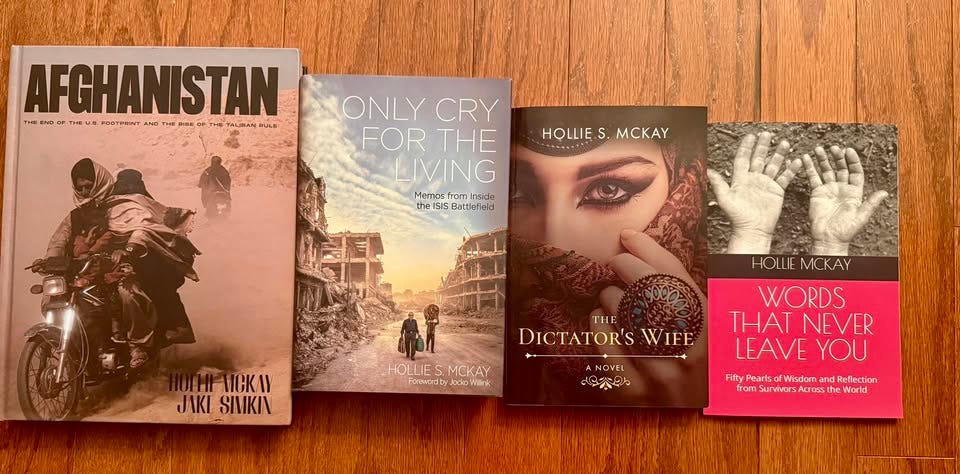
Click to Purchase All Books Here
Excellent article. I've been saying for some time that international law is far too permissive and far too vague, and highly unenforceable. If it remains up to the intent of the belligerent and their interpretations of the law and principles within IHL, then we can see through today's examples that it has become effectively worthless.