

October 2022
On one occasion in Khost, Afghanistan I sit on the floor sipping tea with brave-faced older women and widows who speak passionately about the necessity of women teachers and students. One of the women’s small granddaughters, just nine years old, slips in beside me onto the cool concrete floor with a doll. She says nothing, her innocent, wide-eyed face staring inquisitively into mine.
I learned that this small, freckle-faced girl is already engaged. Her impoverished parents, struggling further under the country’s growing economic crisis, saw no choice but to give her to a much older man in exchange for quick cash, following the custom in which the bride’s family receives payment.
The wedding will happen after her first period. Her schooling has ended; her choices have disappeared. I think of her often. I hold the question of whether that day has finally come. Afghanistan’s cash crisis is exacerbating this already widespread practice.
Nobody in Afghanistan wants war. Yet war still hovers in the dark corners of damaged things when the fighting is supposed to be over.
My own nightmare surfaces in reality. It isn’t the first time. I’ve been detained by the Taliban twice before. A year earlier, near the Pakistan border, the Taliban detained Jake and I, accusing us of being a spy. After tense hours of questioning, the Foreign Ministry confirmed that our passports and press permission letters are genuine, and we were released with a chorus of apologies.
This time, a year later, it’s only my trusted fixer Naweed and I. Earlier that morning, Governor Mohammad Omari of Khost signed off on our visit to a stretch of the border to explore caves once rumored to be Osama bin Laden’s hidden passage between Afghanistan and Pakistan. Hours later, as I wander into the honeycomb of rock, a group of rag-tag Taliban fighters appear on my back of a truck. They speak in quick bursts, pointing at my Fitbit with the excitement of hunters who believe they’ve found their mark: the thin black watch must be a secret espionage device.
Within moments, I’m surrendering my phone, passport, watch — everything — and being ordered into a car. Naweed’s face is drawn with worry as we are shuttled from one compound to the next, Taliban intelligence men leafing through my notebook as though it were contraband, their intrusion feeling as intimate as if they’ve pried open my chest. The bright day gives way to a night with no cell signal, no proof of my permission to be there. Only in the early hours does someone finally reach Governor Omari, who is embarrassed that a guest in his country has been detained and orders them to apologize and give me food. The irony is not lost on me: the man coming to my rescue once spent years in Guantanamo, and I stood in that Cuban facility only weeks earlier. Around me, other foreigners are swallowed whole by this place — kept for weeks, months, years. I am spared again, and the question pulses in my mind: for how long?
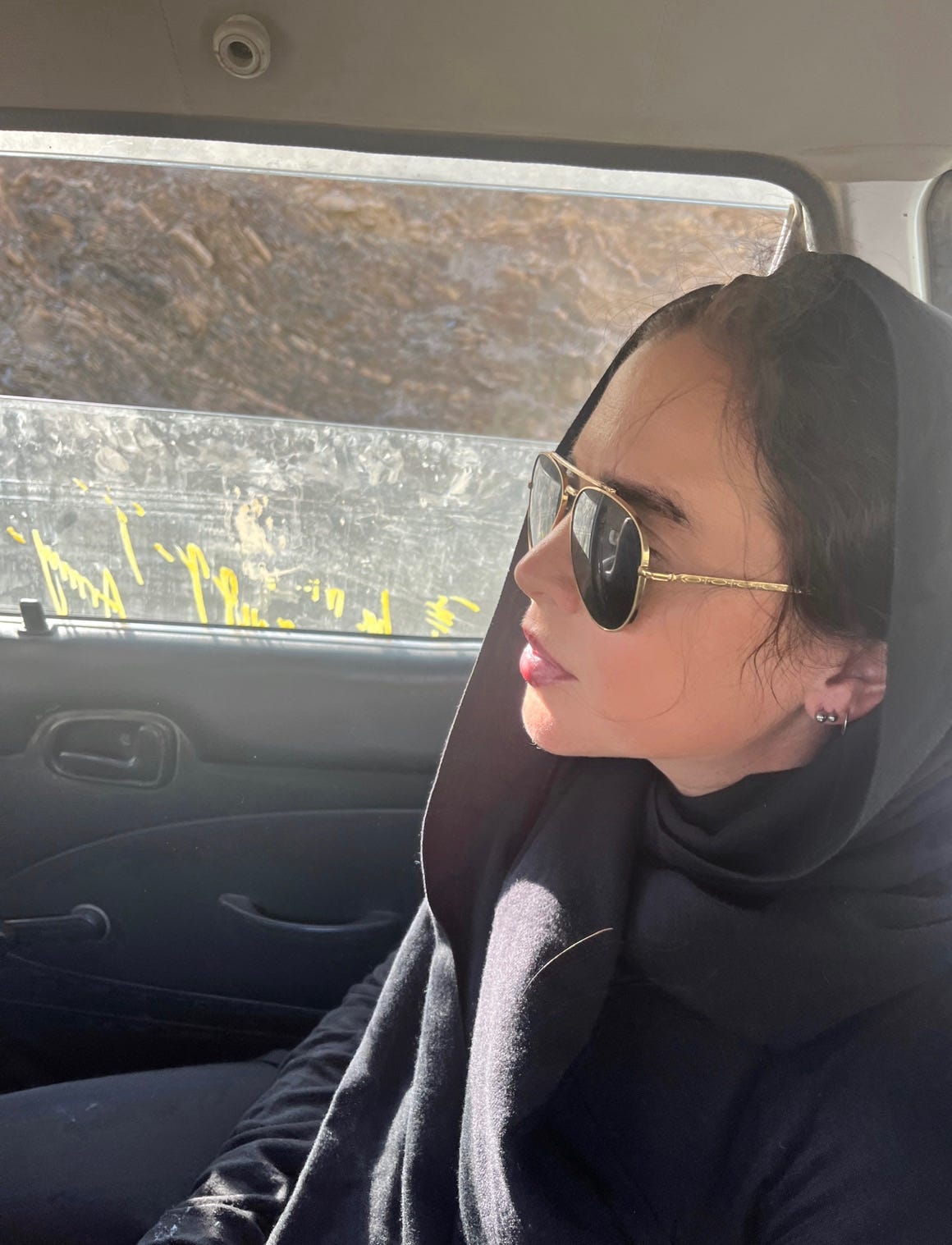
A week later, in the fall of 2022, I board a Kam Air flight to Abu Dhabi, tears streaming down my face as I climb alone into the dying light. I’m not ready to say goodbye. I never am. I always cry when I leave Afghanistan. This time, I cry harder.
The golden sun bounces off the sky’s deepening blue, casting the surrounding mountains in a holy light.
This time it feels different. I don’t know if I’ll ever return. Perhaps I am a mother before I am a mother. I no longer feel like a vagabond, nail-clawing writer trying to make sense of a senseless world. A steady place to plant my feet suddenly seems strangely appealing. Perhaps something inside me has been sanded down around the edges. I do not want to exist behind the hardened shell of a war reporter. We need women in this work who are strong enough to be soft, who seek serenity over bloodshed. No good comes from war. No one ever truly wins. That is not to say we cannot help those most in need, but dropping bombs and blasting bullets into civilian enclaves with a collective punishment approach serves nobody, except maybe the handful of companies, politicians and financial traders who stand to make a buck or two.
War rarely steals the lives of those who chose to start it. It kills the innocent, those who never chose it. There has to be a better way.
As the landscape blanches beneath us, I look down at bleeding, beautiful Afghanistan.
Long flights away from war feel hollow. Time vanishes, tossing me across hours and continents. Yet in those in-between moments, something shifts — between who I was and who I’m becoming.
In Afghanistan, motherhood unfolds amid acute sacrifice. Women’s bodies become vessels of devotion, often at great personal cost, some shot in the stomach during pregnancy, their babies never drawing a first breath. Afghan mothers endure, nurturing possibility and protecting futures, revealing an invincible truth: even in the darkest hours, motherhood is a force of life and defiance.
I want the world to care; to know the babies with bullet wounds, the mothers who have never felt a full belly, the small joys like a first kite. This work is not just about death, but life: bright, brilliant life. When the world doesn’t listen, the only power I have is to write.
On the flight home, eyes closed, a golden oval floats like a tender flame in my mind. It’s warm. It is my girl, the child I know I will find someday, even if I don’t know when or how. She is bright and small, wrapped in light, her presence both fleeting and undeniable. I feel her before I touch her, a warmth in my chest that pulses with anticipation and longing, as if my heart has been waiting for her all along. In that moment, the world narrows to this single, unshakable certainty: she exists, and somehow, we will find each other.
Then the idea of a “spirit baby” drifts into my awareness — not a plan, not a superstition. Rather, a sense that someone is waiting, shaping me in turn. I prepare instinctively, not with cribs or checklists, but by mellowing, strengthening, and readying myself in ways only a subconscious knowing can guide.
In some ways, perhaps without fully grasping it, I am already moving between two dimensions. There is the world, vast expanses of ocean and islands carved into continents that I jet in and out of. Then there is the life of a mother and caretaker, with two feet planted firmly on solid ground.
I wonder which one is slipping away toward the planet’s outermost seam as time passes, which dream I will hold on to, or which I will allow to slip away, or whether there is a way that both existences can flourish simultaneously.
THANK YOU FOR YOUR SUPPORT. PLEASE CONSIDER A PAID SUBSCRIPTION TO HELP KEEP INDEPENDENT WRITING AND JOURNALISM ALIVE. IN THE AGE OF AI AND DRAMATIC NEWSROOM CUTS, WE ARE A DYING BREED.
, "or whether there is a way that both existences can flourish simultaneously".
It may be no coincidence that this is your last sentence.You may have answered your own question.