

On a morning run near my Pacific Palisades apartment, a tiny studio that was once a hippie hotel for surfers and artists through the 1970s and 80s, I observe a homeless man – a man I saw almost every morning for years – dead beside his scrappy blanket. I can only assume he died of a drug overdose, but I do not know for sure, and I probably never will. He died alone, fighting the demons that probably shadowed him for most of his young existence.
The Southern California gloom thickens over the dead waves as I sit in the moist grass, refusing to splinter just enough for sunbeams to peek through. With little fanfare, the police and ambulance take notes and take the body away.
The regret of not speaking to that homeless man I passed by for years, not knowing his name, and not handing him money is overwhelming. I arrive for my eighth Oscars in an old, cheap dress that weekend. I recover from the back of my closet, not bothering to do my hair or even throw on a pair of heels. The thought of going to a showroom to borrow a figure-hugging designer gown or spending a fortune on something new seems like a waste of energy for a writer who doesn’t care to stand alongside the A crowd. I glance around at the lights and cameras and the fawning over people who play characters and wonder why those doing real work – saving real lives – don’t get the same kind of notoriety and praise.
I’m in my twenties, and I leave halfway through the too-long ceremony, shuffling across to “In-and-Out” burger, wondering how I will escape this trap. What business do I have at the Academy Awards when I don’t even own a television and rarely see a movie or two each year? Like the little girl rising in pointe shoes for the first time, I feel my life depends on it and return to the only thing I know I love: the far-flung. I don’t want to be anywhere but the far-flung.
I am strangely at peace in a place where most people probably should not be at peace. It may be naivete or something akin to finding a place where I could someday belong.
Every child you meet in such a desolate setting wants to be a lawyer or doctor when they grow up, to illuminate the injustice and lack of medicine for the war-wounded and weary. An Iraqi child named Sara, eight years old, wears a blindingly bright pink sweater inside another prison-like encampment. In a shy yet matter-of-fact manner, she explains that she wants to be a doctor for two reasons: she is fascinated by metal instruments and wants to be of use.
“I want to save my people,” she whispers into my ear as if sharing a birthday candle wish she should not say too loudly.
Isn’t that all any of us want? To somehow be of use?
Sara has just returned from Sunday school, clutching a red Bible the size of her palm. It intimidates me how tenaciously a young child adheres to faith. The war volley has wiped out many Christians’ possessions and homes. Only their memories and their belief in something greater than themselves cannot be erased.
The Sunday morning after I return, I drift alone to my favorite church close to the sea, constructed in 1925, and the inspiration behind Bing Crosby’s 1944 classic “Going My Way” about an unconventional young priest taking over a parish from a veteran. I step inside that lovely and old St. Monica’s Cathedral in Santa Monica – and I fall again for the ritual of lighting candles. I imagine disseminating luminosity into a hurting world. My eyes are drawn to the orange hue that envelops everything, licking so close to my flesh but never burning. I return to the back pew. Tears roll down my cheeks as if to remind me there are so many emotions I have yet to experience.
I have already descended the rabbit hole of life, a life of addiction and purpose, and I know I cannot back away from it.
Human stories are far more interesting and compelling than military elements (what journalists call “bang bang” in war reporting). I view this as using “the micro,” one’s individual story, to convey a much broader picture of a conflict, “the macro.”
Again and again. Trips. More trips. Days. Weeks. Months.
“I think you are addicted to sadness,” my dear friend tells me bluntly as we chain-smoke cigarettes on that little Los Angeles balcony by the beach.
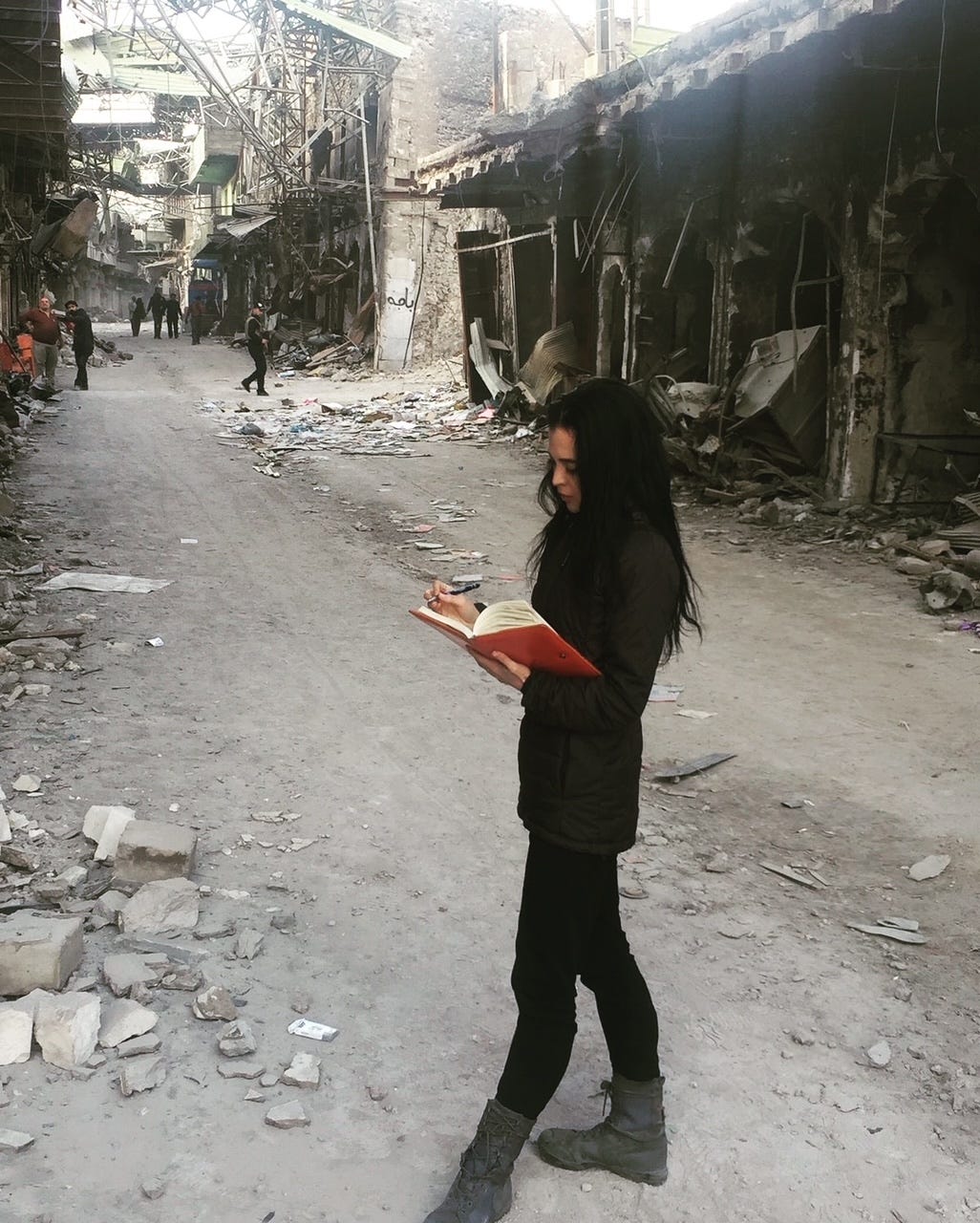
I take a long, rugged breath and think about what she said. Maybe, or in part, she is right. I am slowly becoming a maniac, vacillating between together and pulled apart. We all know the stereotype of a wild-living, emotionally tangled conflict reporter. Am I morphing into the stereotype I never wanted to be? Iraq teaches me things about war I wish I did not know, but you forget that people don’t know.
I had spent all my days and nights reporting on and writing about these tragedies that chew hunks of the soul. Yet not everyone reads the stories you write – or at least not every one of them, and if they do, it cannot possibly stay with them the way it stays with you. The one who lived and breathed it. What is chillingly familiar to me is a silent movie to almost everyone else, even those you love most.
I think I am not so addicted to sadness but rather to the notion that my job can make a slim difference to others. Of course, this job is selfish, too. It means maneuvering off into the mountains without cell reception, forcing others to fret for days over my safety. Yet, I jump on planes with zero regard for anyone else but myself and the stories I long to tell.
Everyone keeps telling me this is not a job I can do forever. Someday, I will burn out, want babies and long-term boyfriends, live in a zip code with a garden, and happily allow the airline miles to expire. I am now even more stuck in my ways, determined to prove them all wrong.
Still so young, I cannot imagine doing anything but this – it isn’t a job but a lifestyle. It encompasses everything I have to give. When I am not writing, I am reading, listening, and learning. I run barefoot on the beach and sputter through notoriously congested Los Angeles traffic, with Arabic learning books blasting through my ears. I latch on to everyone I meet from a foreign land. They have something to teach me that no book ever could. I am most comfortable nuzzled into green mountains, sipping sweet tea with mourning people who want nothing but to share.
It is an unsafe life that feels safe. When war cascades like a storm around me, I do not have to be more than I am. I do not have to worry about cars, relationships, and rent payments. In war, I can just be. Everything is in its place.
Somehow, I keep going back to Iraq, to Syria, to Yemen, to Afghanistan and beyond. It is perhaps an emotional co-dependency more so than a physical one. War gives me a place for my sadness, a place for the depression to feel normalized. Like dance, war became a place for my melancholy and satisfied my yearning for depth.
Every time I return home, I subconsciously try to replicate that life with those who come from these lands I have grown to love. I smoke hookah with Syrians and learn home cooking skills from Libyan mothers. I play music with my Iraqi family in San Diego and go to Pakistani weddings and birthday parties with new and different communities. There is something I can relate to about life in exile: the notion of craving a country that no longer exists or that you can never return to by choice or force.
Before each trip, I put together a proposal that features storylines and a draft schedule that will, without a doubt, change the second I step onto the tarmac. I develop a budget for flights, drivers, interpreters, lodging, and food. Unlike the much more valued television reporters, I am responsible for all my own security and contingency plans. I do not book business flights, despite it being company policy for all staff flying more than six hours. I don’t receive fat emergency cash advances the way other journalists do. I stay on floors far from green zones, rather than five-star hotels, and I try to do my work on as lean a budget as possible. I am never offered security personnel. But I do not grumble or raise the issue.
Moreover, my signature trait is going under the radar and living as “locally” as possible when on assignment. It is how I dig deep into the unraveling plots without drawing attention to myself.
I move to New York. I lust for the city, yet I can’t wait to leave it. I fall deeper for Afghanistan. I fall for all her fears, flaws, and contradictions. I fall for stepping into a rough draft of history, for experiencing a place that sent our lives as teenagers spiraling.
Upon leaving in early 2017, I am teary in gratitude for my fixer Moslem – a former defense attaché splitting his time between London and Kabul and the Panjshir Valley – who becomes something like a father figure to me, a fierce protector. A war zone instantly draws us close to those we entrust our lives to, the locals around us. Moslem was once the personal guard to the great “Lion of Panjshir,” Ahmad Shah Masoud, as it is an immense source of pride that pivots every conversation we have.
Fixers like Moslem are vital to a journalist working in a foreign space. They are typically a mixture of interpreters and producers. They arrange meetings and provide pivotal insight, often at high risk to their own lives.
I sit with Moslem in the Dubai airport. I am waiting for a connection to New York, while he is waiting for a connection to London. Before we move to our different gates, I start sobbing as though I am leaving a parent, a protector. One prominent aspect that draws me to war zones is that my family makes it their mission to look out for me and be by my side, something I do not have in my increasingly lonesome American existence. Again, there is nothing and not much to come home to.
Manhattan bounces on as I burrow into my blankets. I should return my dad’s phone calls. I should go to therapy. I should stop stockpiling water bottles in my apartment. I should stop telling the neighbor to go fuck themselves and find more polite phrases when they blast loud music at 6 am on a Saturday. Instead, to compensate for feeling mentally spun and emotionally fried, I learn to ride a motorcycle in the Bronx, buy a Harley Davidson, and sit in French-style bars with neat whisky late at night because I cannot sleep. I do not want to sleep. Sleeping feels like missing out.
I am calm and content in precarious places, however, when a zipper breaks on my snow boot while in Washington DC early one morning, just before I head out for an important meeting, I throw it across the hotel room and almost shatter the Marriot mirror as if this is the worst thing to ever happened in my little life. When you pause, life catches you. The best thing to do is not to pause.
I have more than two dozen little black notebooks spanning apartments and storage units across America. They are like limbs, extensions of my soul outside of who I am, maps of my unmapped mind. I shudder at the thought of ever losing those old-fashioned mementos, the records that have already started to recede from my conscious memory. Those withered black books are my black boxes. Everything that matters lives inside.
I go to Iran. I hold my breath. After a long layover and another cramped leg, I arrive home to New York, crash into my bed, and sleep as I have never slept before. My friend Dennis tells me he has never seen me so depleted. Dead to the world, my bones are exhausted in a way I have never experienced. The many weeks of nervousness and anxiety are more tiring than running back-to-back marathons. I think long and hard about how millions of people live each day: the people in repressive places pushing against their tyrannical governments. I can only imagine how they deal with every moment, knowing they could be dragged into dungeons or even killed at any moment. It takes a special soul to fight for that liberty I never had to earn.
For a little while, I stay in WhatsApp contact with the young Iranians I met by the foot of the golden bridge. Hellos and goodbyes, and Happy Birthdays. Protests erupted months later, which they texted me about with such zest. Then, one by one, they each disappeared. To me, the bravest people and the bravest journalists are not always the ones who wear Kevlar vests and helmets and push back against an invading force.
The truly incredible ones are those who do not stand up to a foreign government per se but to their own – to their own repressive regimes that will just as quickly hurl them into torture prisons or kick them to the gallows without so much as a second glace. Iranians are among the most courageous of them all.
The season changes. I return to Iraq, to a country that has supposed to have defeated the ISIS threat, yet I returned to a country that resembles the forgotten ends of the world. I dig up mass graves, some skeletons and some acne-mottled faces of too many too young to die. But there are no victors here. Maybe only the military-industrial complex, I suppose. Fighter jets brought Mosul and many other cities to their absolute knees. I am no military planning expert, and I can surmise that perhaps there was no other way but to call this a win felt like a fat lie.
I fly back to New York just before Christmas, just in time to walk absently through the Christmas Markets in Central Park, witness the first flutter of December snow glazing the sidewalks, and sip mulled wine on my apartment floor as I gaze into nothingness. Whenever I return from these places, I am never sure that my words matter too much. But I am not sure enough to lose hope. Away from war, I live my life with a stinging hollowness. I can only think about when I can get approved for another overseas assignment.
I spend Christmas Day and New Year’s Eve alone. I am soaked with emotion, a little lost and shamefully feel sorry for myself. Who am I to feel sorry for myself? To feel anything but gratitude from this New York City existence? You see so much suffering, and you think, who am I to feel pain? To grapple? So, we don’t seek help and slip further into the abyss.
I worry a lot about whether I am part of a profession that thrives off benefiting from someone else’s hardship. That is the last thing I would ever want, and the idea rattles me in the early hours of almost every morning, at the gym and roaring across the city on my Harley. Will I know if I have sold my soul? Will there be someone there to tell me? I remind myself that it is okay to make just enough money to pay my bills and fill my stomach and that if it weren’t for writers, reporters and photographers, there is so much about war we would not know. After all, those who craft the policy from elegant white towers on the far side of the Potomac don’t venture into danger, and if they do, it’s a choreographed and sheltered fly-in and fly-out.
The sublet of my safe little Upper West Side apartment is up, and the owner wants to move back in. On Craigslist, I find a cheaper studio in a rundown building in Chelsea. It’s a little bigger than a shoebox. I can barely fit a bed inside. It is much busier than the Upper West Side; the downtrodden apartment is a little cheaper. I barely make ends meet in Manhattan, getting by on a small salary that has only increased in minute increments since I was first officially hired at age twenty-one. I promise myself that the trade-off is worth it. Not many people get to walk where I walk and see what I see. To continue doing my work makes me feel wealthier than any of the Wall Street bankers I know. But perhaps I’m haunted by the notion of being or doing something ordinary. I might be poor, but at least I would not be ordinary.
“Do not work primarily for money; do your duty to patients first and let the money follow; our life is short; we don’t live twice; the whirlwind will pick up the leaves and spin them, but then it will drop them, and they will form a pile,” is my favorite line in my favorite book, “Hiroshima” by Chinese writer James Hersey.
When I am trapped in conversations about venture capital and public relations deals and buying Ferraris and houses in The Hamptons, I feel as though I am the only one who cannot speak the language, who does not want to speak the language.
I careen from corner to corner, from one conflict patch to the next. To be the best reporter I can be. I want to soak in every angle and facet of war. I want to leave no stone unturned. I am a ballerina who also wanted to be best at every other style, from jazz and hip-hop to contemporary and choreography. I don’t want to be the master of one, but I want to sip it all into my bones and poke my head around every corner.
After another trip to Syria, I fear the thought of eventually going home. I do not know if home is a place of home is the road, serpentine and uncertain. I feel as though I belong to my fixer Mazloum’s family. Again, it’s an addiction to a doting circle, of company, of anything to evade my beautifully lonely American life.
Over the border in Iraq, help dig up more mass graves from the bowels of an ISIS jail in Tel Afar, watching feebly as the remains of handcuffed bodies – nothing left but bloodied clothes and a blindfolded skull – are dragged up from the sewers in the Spring stench. It doesn’t hit me the way it should, but it strikes me enough to know I am still breathing and feeling. Still in touch with all the horrors that war induces.
Less than twenty-four hours later, the stench of decomposing flesh stapled to my senses, I anxiously board a flight back to New York. I burst into tears in the taxi ride to my Chelsea apartment, shaking it all off, feeling like a failure that there was no one there to pick me up, obsessing over why I had created such an isolated world for myself. The taxi driver asks me if I am okay, and like a crazy cat lady, I begin madly telling him all about the executed bodies and bombers and dead babies. He looks sorry he asked.
I wipe my eyes and close my mouth. Before crossing the bridge back to Manhattan, I silently protest a life oozing with normalcy, drafting emails and pulling up my schedule to determine my next trip. I want to go to Yemen. I will not stop. I can’t stop. If I can keep going and planning trips to keep me on my toes and move forward, I will not have to collapse into a puddle and wade through everything. I am back in the office the next morning. No one glances up from their desk.
A couple of friends tell me I am brave. I do not feel brave. The truly brave people are the ones stuck inside the line of fire, who cannot flash a coveted blue passport and run away to safety whenever they (or, in my case, employers) insist it has been long enough. I fear something I cannot touch. I buy a padlock for my apartment. There is nothing wrong with an extra layer of security, right? I blacken the window so it cannot be deciphered if the lamp is on or off, thus whether I am home or not home. I eventually become decent enough in Arabic, but I never felt as though I grasped the language to the point where I could dream in it or confidently hold a conversation. Perhaps I am too steeped in English words and phrases, and when the Arabic became too much for my brain to absorb, I turned to studying the thesaurus on long plane trips instead.
There is this life – fleeting, late nights, drunken dates, whirlwind love affairs, railroads to The Hamptons – and then this other life that pushes me far away. I have no choice in any of it. An inability to stay. The frustration of having to leave. My parents celebrate forty years of marriage, and I scratch my head.
Contrary to their stability, I am more adventurous, easily bored and a bolter. I want to settle down and take care of myself for the rest of my life. Well, I tell myself that and part of me really believes it. But I also want to hide behind walls and find something, someone, that doesn’t exist.
I take a leap of faith. I profess to be my own boss and I venture into the realm of independent writing where nobody can tell me what to do. I pack up my things and ship them to storage. I return to Afghanistan before the fall. And because nobody can order me on an evacuation flight, I stay.
Months later, flights to a few outside countries resume. My stockpile of cash is almost finished. I reluctantly admit to my photographer, Jake, in early December that it is time to go. I have no home to go to, but the U.S. is still my home, even though I do not have a home there to return to. My life beyond the war zone bubble, and war zones are a perplexing bubble, is passing me by as each day merges into the next. I am not getting any younger, and I cannot help but wonder if there is more to this life than wars, careers, and a profession that defines our lifestyles and who we are. Is there more? And if there is, am I capable of balancing both?
I board a Kam Air flight to Abu Dhabi on an old plane packed with fighters, tears streaming down my cheeks as the plane climbs higher and higher into the dying day, the damp Kabul below dissolving into the distance. I am not ready to say goodbye. But I am never prepared to say goodbye. I grieve the person I was there: the one who held it together, the ones roaming without rules and the one sitting in silence with people who had overcome scenarios I had never imagined possible.
Long flights away from wars are idle hours. The concept of time does not exist since you can be pushed forward or backward an entire day without missing a beat. Yet they fill the void between who I was and who I now am, leading me into an unwanted reality with all its bills, stresses, and social calendars and commitments. Bloodshed makes me feel more secure than in this other world—the one stuffed with monotonous conversations about money, materialism, and bikini bodies on Instagram. Instead, I want strangers to know about the agony others endure, the babies filled with bullet wounds, and what it’s like to give a child their first kite.
It’s not just about war and death. The obsessive profession is filled with light and life as well. Does anyone care? Is anybody there? What you write, say, or do occasionally ripples in the frenetic news media cycle far away. Yet when you’re in it and writing in war, words vanish into a black hole because nothing changes. Nothing and everything.
This is how it feels to watch the anguish of others and have no power to change it. The only thing I can do is write about it. And when I leave a blood-stained place, not all of me leaves that place. Conflicts always find me, hold my hand, and haunt me even when I try to bury myself in the most remote parts of America—the dead and desperate return. There is no sign-off for the day, and there is no Slack channel I can snooze.
I land in New York City. Again, there is no one there to pick me up. I am embarrassed. Why have I created a life in which there has never been someone there to collect me after an assignment away? When troops return from deployment, do most have loved ones to greet them? Is anybody there? It is the most miserable and alone I have ever felt in my life.
I can’t get a cab at the overflowing JFK. I sit in the gutter with my bags and cry a drained, ugly cry.
“Ma’am, get out of the way,” a gruff JFK worker snaps, pushing a luggage trolley in my direction.
“Fuck you,” I blurt back.
“Fuck you,” he counters in a thick Long Island accent.
I can’t help but laugh through my tears. I’m home. Well, to a shoebox hotel, that is.
Less than two weeks later, I am worried that my memory is dimming. I write and write, noting down random stories and conversations and describing Afghans I met who I do not know if I will ever see again. Only there are things I cannot lasso with language. I sleep on the floor against the wall. I feel more comfortable on the floor, pressed against something solid. That way, I can pretend I’m not alone. The moonlight shining down on the snowfields casts a murky veil of light. It’s not dark enough to fall asleep. If I do sleep, I do not dream. If I dream, the dreams resemble glass – fragile and breakable – and the looped movie of memories wakes me.
In January 2022, Ukraine emerges. I sign a lease in DC without even looking at in, consolidate some of my possessions from storage and throw everything inside in the middle of a snowstorm. A day later, I pack my bags again, and I do not look back.
Weeks after the full-scale Russian invasion, my mind is breaking down. Everyone is messaging me — old bosses, my parents, friends, boyfriends from years past. How are you leaving? When are you leaving?
I have no exit plan, no corporate behemoth to fund or secure a way home. I stare down at the deep second-degree burns on my thigh — at the melted skin, the weeping red inside my flesh — and pray to remain infection-free.
The truth is, I rushed into Ukraine alone in the weeks before the war, with no real plan for how I’d get back out. Suddenly, I’m panicked and isolated, longing for a teammate — someone, anyone — to give me a giant hug. Friends, family, and former bosses are avidly texting, pressing for my escape plan, raising alarms over the growing danger.
A few days pass. My inner alarm bell rings. Exhausted and acting on impulse — because I know I can’t afford the exorbitant rates local drivers are now charging foreigners for the long, melancholy drive to the Polish border — I stuff my small suitcase with whatever fits and head for the train station. I wait for hours in the uncertainty of yet another 36-hour lockdown and finally board an old train, where people sleep between carriages and stare silently into steamy windows, willing them to reveal safety.
Almost fifteen hours later, I arrive in Lviv in the early morning darkness, lost and raw with emotion. A random but kind American medic named Luke takes me under his wing. Together, we drive a few more hours to an overflowing border crossing as air raid sirens scream into the cold morning air.
I walk into the milky light, trying to wrap my head around how I’ll make it to a civilized town — and eventually, back to my apartment. I breathe a sigh of relief that my still-oozing thigh is infection-free. The sirens fade as I disappear into Poland, but the words of some Kyiv officials — The worst is yet to come — ricochet in my mind like a hollering wind.
I made it through the storm. Through weeks of bitter cold with nothing more than light cotton layers. Without an infection. Without falling apart. I don’t know how I worked — but I did.
I vow to return to my barely touched DC apartment and sleep. I vow to sleep so much that I dream. Then, I promise to return.
Three days later, I toss my new iPhone at the wall. It doesn’t shatter into a thousand pieces — just leaves a nasty dent in the drywall of a new apartment. I have never felt such unshakable anger in my entire life. Ever since I came home, I’ve been blue, erratic, down and out — a raging bull, lost not only to loneliness, but to an outrage verging on hysteria.
I’ve been wet and cold for almost six months straight, from Afghanistan to Idaho to Europe to Ukraine, with frigid excursions in and out of the snow-crusted East Coast in between. I hate, vehemently hate the world. I hate the scammers with GoFundMe pages in Ukraine taking money only to parade as war tourists, capitalizing on the goodness of generous Americans genuinely trying to help. I hate the vulture journalists shoving cameras in the faces of traumatized people as they are being rescued. I hate the fact that this war serves nobody at all.
The Russian people lose, the Ukrainian people lose, and the European and American taxpayers lose. Maybe the weapons manufacturers win? War is a game of losing, no matter how you slice it. I hate that I am fighting out against the world, but I cannot stop it. I hate that I feel so inadequate in a city like Washington, DC, where my imposter’s syndrome climbs to unprecedented heights. I can’t help but feel I am looked down upon for not having multiple Master’s Degrees and a pedigree of Georgetown or Harvard. It is a city tinged with the sort of elitism that makes you forget you earned your unofficial doctorate in the streets, that you have been a part of history most can only read about in textbooks.
I hate life for no discernible reason. I hate that I am so ungrateful for my safe, privileged existence when so much of the world is suffering.
Is anybody there?
It turns out there is, and I was yet to experience what was the most fascinating experience of my life—far more gripping than any war zone.
In the twilight of thirties, I finally understand a life not defined by career and profession. It’s an offshoot of growth I once thought was terrifying.
(Part Two Coming Soon).
FOR EXCLUSIVE GLOBAL CONTENT AND DIRECT MESSAGING, PLEASE CONSIDER A PAID SUBSCRIPTION TO THIS SUBSTACK TO HELP KEEP INDEPENDENT, AGENDA-FREE WRITING AND JOURNALISM ALIVE. THANK YOU SO MUCH FOR YOUR SUPPORT.
For speaking queries please contact meta@metaspeakers.org
For ghostwriting, personalized mentoring or other writing/work-related queries please contact hollie@holliemckay.com
Follow me on Instagram and Twitter for more updates
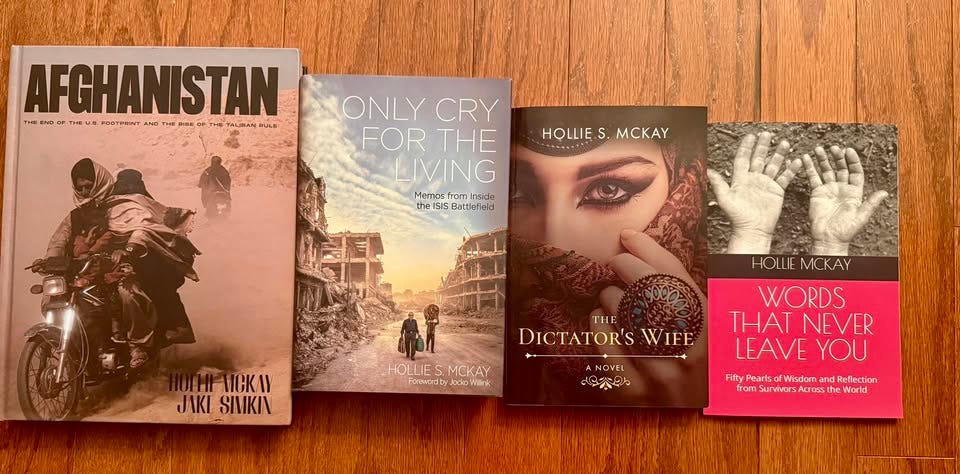
Click to Purchase All Books Here
Writing about the world‘s self-inflicted pains is so important - especially the way you do it, up close and intimate. You are integral to the planet’s nervous system.