

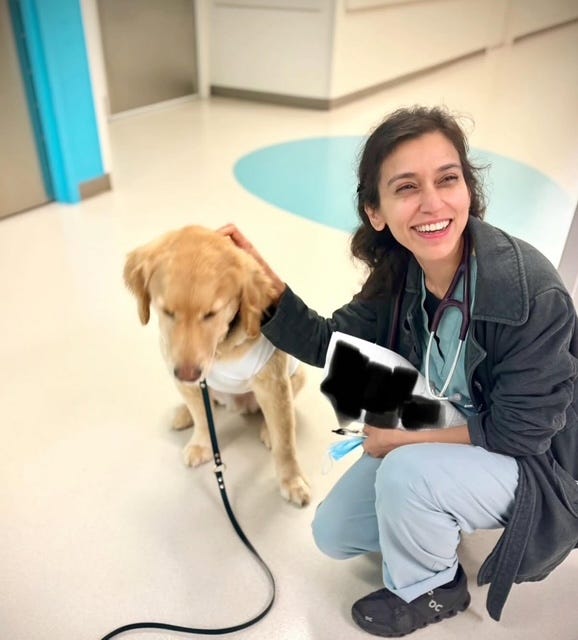
Dr. Seema Jilani has dedicated her career to mending broken bodies, yet it is the fractured systems that perpetuate suffering that trouble her waking moments. A pediatrician, war physician, and mother, she has stitched children in post-conflict Bosnia, evacuated infants from Syria, and delivered critical aid to those affected by conflict in Lebanon, Egypt, Iraq, Afghanistan—and most recently, Gaza.
For all her accomplishments, her story is defined not by statistics or accolades but by an unwavering devotion to dignity, especially the profound bond between mothers and their children.
Born in New Orleans to Pakistani parents who fled India during Partition, Seema’s upbringing spanned continents—Nigeria, Indonesia, Venezuela, and England—alongside a father who worked in oil and gas and occasionally moonlighted as an Elvis impersonator.
“It gave me that Third Culture perspective,” she reflects, “a lens of both belonging and displacement.” Though surrounded by doctors in her South Asian community, she initially resisted the path.
“I wanted to be different,” she continues. However, her first trip to Sudan in 1999 proved transformative.
“I passed out during my first operation,” she recalls, “but I fell in love with medicine. I saw its intimacy, its grace.”
After training at Texas Children’s Hospital—the largest pediatric facility in the world—Seema began working medical evacuations, flying globally with critically ill children. She witnessed firsthand how privilege could lift a child from the brink of death. She also saw the devastating consequences when such privilege was absent.
In Gaza, that absence resonates with every breath. Seema first traveled to the Palestinian territories in 2005 as a medical student, part of a group of Jewish-American doctors.
“We walked hand in hand through the West Bank and Gaza. One of them still calls herself my Jewish mother,” she recounts. “It was the beginning of a lifelong friendship—and a lifelong heartbreak.”
That heartbreak has only intensified with each return. In Seema’s most recent Gaza deployment, from December 25, 2023, to January 8, 2024—just months after the Hamas-led massacre in Israel and Israel’s subsequent military campaign in Gaza—Seema bore witness to an unparalleled level of devastation. By then, more than 22,000 Palestinians had already been killed, with women and children accounting for an estimated 70 percent of casualties.
The hospitals she visited were barely functioning, forcing doctors to operate without anesthesia. Premature babies perished in incubators due to lack of electricity. Over one thousand children had lost limbs, and countless others were buried under rubble. The death toll has since climbed beyond 37,000.
“I’ve worked in many war zones,” Seema tells me, “but I’ve never seen this proportion of children affected—the staggering number of pediatric amputees, children burned and concussed.”
The psychological toll is equally immense, with an estimated 1.7 million people, including 800,000 children, displaced within Gaza, facing a profound lack of mental health support. Over 620,000 children are out of school, further jeopardizing their futures.
Stationed at Al-Aqsa Hospital as the Senior Technical Advisor for Emergency Response at the International Rescue Committee (IRC), a leading global humanitarian organization, Seema juggled both medical care and logistical support, coordinating supply chains, negotiating access, and overseeing humanitarian distribution.
“We brought everything in ourselves—food, water, medicine—so we wouldn’t strain the already collapsing local system,” she explains.
Yet, even with meticulous planning, nothing was safe. The guesthouse where Seema stayed, declared “deconflicted,” was bombed a week after her departure. Each day, she traveled along what was supposed to be a safe corridor to the hospital. However, toward the end of her mission, even that assurance began to erode. A bullet pierced the Intensive Care Unit. On her final day, Israeli authorities failed to reauthorize the corridor, preventing her from reaching the hospital at all.
Inside the emergency room, the cases mounted. Mothers arrived dazed, clutching bloodied babies. One fourteen-year-old girl, severely burned, incessantly called for her mother—who, as they would later learn, lay dead beneath a crushed building.
“There was no one left to advocate for her,” Seema says, her voice catching.
For the women still living, the decisions are fraught with the unthinkable.
“If your child has an asthma attack, do you risk the journey to a hospital that might be bombed? Or do you stay and hope it passes—knowing your child could die?” Seema asks.
Mothers gave birth in classrooms, in mosques, and under tents. More than 180 women went into labor each day during the height of the conflict, often without anesthesia, antibiotics, or trained professionals. Some babies were born with glass in their lungs. Others died before their mothers could even cut the cord.
Long before Gaza, Seema had seen similar devastation: personal, raw, on the outside looking in at a nightmare that belongs to you.
On August 4, 2020, while living and working in Beirut with her family, she narrowly survived the catastrophic port explosion. At first, nobody had any idea what it was. Much later, we would all learn it was the largest non-nuclear blast in history. After stumbling from her car, dazed and bloodied, Seema immediately sprang to action. She hurriedly started treating a screaming woman nearby who had lost her ear.
Moments later, Seema’s husband called. It was a call she can never forget.
“Our daughter’s been hurt,” he said. “Badly.”
Seema ran home, a terrified mother bracing herself to shift into composed medical mode to save her precious girl’s life.
“There were blood prints on the stairs, pools on the floor. I found her—she was crying, gashed open,” Seema remembers. “I was singing lullabies while assessing concussion symptoms. Holding pressure on her wounds while checking oxygenation. Doing the clinical math in my head.”
As it turned out, a massive explosion ripped through Beirut’s port when a warehouse storing 2,750 tons of improperly secured ammonium nitrate ignited, killing more than two hundred people, injuring thousands, and devastating entire neighborhoods.
The blast, one of the largest non-nuclear explosions in history, was traced to years of official negligence, as repeated warnings about the chemical stockpile went unheeded. Years later, no senior officials have been held accountable, and political interference has repeatedly stalled investigations, leaving victims’ families without justice.
Inside the emergency room, medics attempted to stitch her daughter without pain medication. Seema pushed back.
“I administered ketamine and oxygen myself,” Seema says. “I’m grateful I was able to spare her that memory.”
That is, the memory of unthinkable agony. Seema’s thoughts drift back to Gaza, where another little boy around the same age brought in from a blast was not so lucky.
“We had no ketamine. He had to be stitched raw,” she says. “I couldn’t stop thinking about it.”
I have such tremendous respect for medical professionals in war and often find myself wishing I had buckled down and pursued such a transformative road in this life. Writing, bear witness, can in the middle of a maelstrom feel as useless as it is important.
Seema observes that it was not necessarily being a mother herself that made the experience all the more guttural.
“People say, ‘I understood once I became a parent.’ But I had empathy before she was born,” she says. “Still, becoming a mother made me more sensitive—to how we speak to parents and how we validate their intuition. When a mother says something feels off, I listen.”
I can very much relate to those words. I found my way into the world because I wanted my world to care for the uncared for far away. Yet I would be lying if I said becoming a mother did not change how I see the world, transform how I write, and the woman I am growing into. War no longer feels distant—it presses against my chest.
But I also believe it is not everyone’s path to have to give birth to feel that shift. The instinct to protect, to nurture, to love beyond reason lives in anyone who chooses to care. That pull isn’t just maternal. It is human.
Decades of work in war zones, in the throes of the war in Gaza, and in emergency rooms in the United States of America, Seema is no longer as idealistic as she once was.
“I used to believe in systems. That if you presented evidence—data, eyewitness reports—people would care,” she explains. “But Gaza ripped that away. The truth is, everyone knows. They just don’t value brown lives the same.”
She pauses.
“I briefed the UN. I spoke to White House officials. I’ve done the interviews. But at some point, telling another horror story just becomes trauma porn.”
I could very much relate to what Seema had just said.
The very question, “Are some human lives worth more than others?” is deeply uncomfortable, yet throughout history, conflict has forced this notion upon societies. When war breaks out, lines are drawn, and suddenly, the people on one side become “us,” and those on the other become “them.” It's a psychological trick, often reinforced by propaganda, nationalism, or fear, that erodes empathy and breeds a dangerous belief: some lives are inherently more valuable than others.
Like Seema, I have long worried about whether I entered a profession that thrives off benefiting from someone else’s hardship. That is the last thing I would ever want, and the idea still rattles me from my sleep. Will I know if I have sold my soul? Will there be someone there to tell me? In my days as a free bird, as my friend Dennis called me and still does so, I reminded myself that it is okay to make just enough money to pay my bills and fill my stomach, and that if it weren’t for writers, reporters, and photographers, there is so much about war we would not know.
Motherhood has changed that mentality a lot and not at all. I have more than my own mouth to feed. Yet, I cannot shake the notion that I need to do something with my life that reaches beyond the troupes of prioritizing a paycheck.
“Do not work primarily for money; do your duty to patients first and let the money follow; our life is short, we don't live twice; the whirlwind will pick up the leaves and spin them, but then it will drop them and they will form a pile,” is my favorite line in my favorite book, “Hiroshima” by Chinese writer James Hersey.
When I’m caught in conversations about venture capital, PR deals, and Washington networking events, I feel like a foreigner in my own tongue—unable, and uncertain, of how to speak that language. Seema, too, speaks in another dialect entirely: the language of war, stripped of its bells and whistles, raw and unvarnished.
Seema also became disillusioned with the aid industry itself. Before briefing a major humanitarian organization, she was informed that the very high-profile president needed to hear her account “in an Oxford accent.”
“That’s the level of performance expected,” she said. “I realized the most effective organizations aren’t the big names with PR departments. It’s the tiny, shoestring NGOs, often led by local women, doing the hard work quietly.”
Now based in Houston, she practices inpatient pediatrics, treating patients with heart disease, cancer, asthma, and those undergoing transplants.
“At least I know it works here,” Seema says. “I can make a difference.”
She raises her daughter—the one who survived Beirut, the one whose scars are still knitting themselves closed. Now nine, and in therapy, her daughter is beginning to grasp the nature of her mother’s work. Before each new assignment, Seema tries to explain in a way she can bear:
“There are sick babies who need my help,” she tells her daughter. “That helps her make sense of the danger—why I keep going.”
When Seema returned from Gaza, she reached for the only ritual that could liquify the images in her mind.
“I kissed every toe, every joint, every finger on her body,” Seema says softly. “I’d seen too many amputations. Too many limbs taken before their time. I go home and listen to her heartbeat. That sound? It’s everything. It keeps me going.”
For this doctor, those small moments of presence, the healing, now define her work and her driving purpose.
In a world numbed by tragedy, Dr. Seema Jilani remains a vessel of humanity. Not every child can be saved. But every child can be seen. And every mother deserves to be believed.
War destroys bodies, homes, and certainty. It lingers long after the last bombs fall. Yet in the quiet that follows, something stubborn remains. To be a mother is to carry both ruin and wonder, to hold a child close while making impossible choices, showing up again and again. Motherhood doesn’t demand perfection, only presence—steady, instinctive, and bright. Survival becomes its own form of love: mending wounds with lullabies, protecting small moments of peace, and keeping an unspoken promise that even in the darkest hour, someone will kneel beside the pain and say, “I see you. I’m still here.”
“I’m still here,” Seema adds, interrupting my train of thought. “And I still care.”
PLEASE CONSIDER A PAID SUBSCRIPTION TO THIS SUBSTACK TO HELP KEEP INDEPENDENT, AGENDA-FREE WRITING AND JOURNALISM ALIVE. THANK YOU SO MUCH FOR YOUR SUPPORT.
For speaking queries please contact meta@metaspeakers.org
Follow me on Instagram and Twitter for more updates
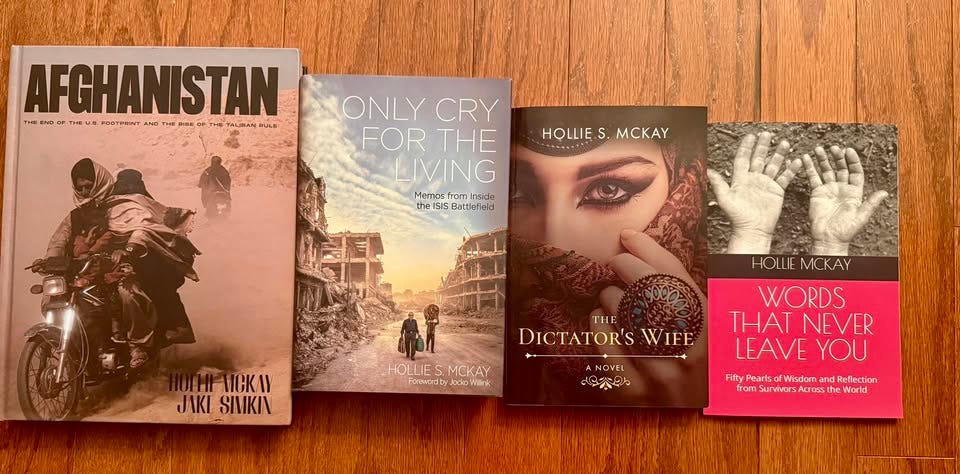
Click to Purchase All Books Here